
III. The Motives for Christian Perseverance
For God is not unjust to forget your work and labor of love which you have shown toward His name, in that you have ministered to the saints, and do minister. – Hebrews 6:10.

Two motives for perseverance are in this passage:
The first is here in verse 10. Simply reflecting on God’s reward of our perseverance is a motive to continue. Perseverance comes through reflection on His reward. God is not unrighteous or unfair to forget your labour of love. What does this mean? The idea of forget here does not mean accidentally lose a memory. God is not subject to such weakness. It has the idea of overlooking, neglecting, dismissing, treating as nothing. Were God to see the diligent labours of His people, their toil in serving God by serving people, the sacrifice and the pain, the loss and the inconvenience, were He to see that and ignore it, Scripture says He would be unjust, unfair. Yes, indeed, we are rebels who deserve the incarceration of eternal fire. Yes, we can make no demands on God or expect anything from Him. And yes, in heaven we see believers throwing their crowns at His feet, understanding that everything was from Him and through Him and to Him. But with all that in place, God is still the very essence of kindness and generosity. He is quick to mark the slightest effort to please Him. And while He is very difficult to satisfy, He is extraordinarily easy to please.
Such a God is not an exacting auditor, who will remind us on judgement day that everything we had was on loan anyway, that He owes us nothing, and that we ought to be grateful to have escaped Hell by the skin of our teeth. No, while all that may be true in a judicial sense, we read that God takes special joy in rewarding His imperfect children. We know something of this. When our dogs return a ball, dripping with dog-drool, with their tails wagging and their pink mouths panting, we tell them what good boys they were. When our babies return nothing more than a gummy smile to us, we rejoice and tell them how good they are. When our children bring us their scribble art-work, where the people don’t have torsos, but have legs and arms coming from their heads, we congratulate them, and stick their drawings up. We don’t gain anything from dog-dribbled balls, or gummy smiles or wax-crayon stick-figures. But our love leads us to reward our beloved.

God does not gain anything from the service of His people, but He delights to receive it. God is not miserly in His loving reward of His children. Yes, every effort we made came from Him, but He will not forget the smallest thing done for Him, for His people. So small, Jesus said in that Matthew 10:42 “And whoever gives one of these little ones only a cup of cold water in the name of a disciple, assuredly, I say to you, he shall by no means lose his reward.” So small, Jesus said that something done for the most insignificant, forgotten member of the church will not be forgotten. And in Matthew 25:40, “And the King will answer and say to them, “Assuredly, I say to you, inasmuch as you did it to one of the least of these My brethren, you did it to Me.”
Here is how you keep persevering. You remember, God sees, and has perfect recall. He knows all my sins, but has forgiven all of them in Jesus and chooses not to remember them. So what’s left? Every truly pure good work you do for Him. He won’t miss it, overlook it, think it of little import. In fact, this is why Jesus told us to practice secret religion: praying privately, fasting without a show, giving anonymously, so that we learn the deep power of the Father’s reward. Not man’s applause, not promotion in the church, not position, not influence, not power, but the profound sense that I am working for God, and He sees.
When you are feeling the discouragement of your own heart, or the sluggishness of the flesh, and you desire to draw back, to love less, to serve less, then this is the promise you must cling to: God will not fail to reward every true effort made for Him. It is worth every plodding step. It is worth every evil thing denied, every sacrifice made, every cost embraced.
But there is a second motive given here. Not only does perseverance come through reflection on His reward, but it comes also through imitation of the inheritors.
“…that you do not become sluggish, but imitate those who through faith and patience inherit the promises.” – Hebrews 10:12.
Instead of becoming slothful and dull and lazy, we must imitate some people. Whom do we imitate? Those who have practised endurance, and have entered into the promises of God. Those who have kept the faith, been faithful, faith plus patience, and now they have experienced what they hoped for.
This is largely what chapter 11 is going to be about. The writer wants us to know that there is a massive stadium full of finishers. Each one of them is living proof – and I use the word living intentionally – that you can finish. It is possible. When you know people have endured and not given up under the most extreme persecution, you say, we can do this. We can keep loving God by loving His people. No going back for me, no dullness for me.

I remember watching the Comrades Marathon as a boy during the days of Bruce Fordyce. And in the Comrades Marathon, the race always finishes in a stadium. Now I can’t imagine the pain on running 90 kilometres, but evidently a lot of people do so intentionally. And as the day goes on, people finish at different times, and they have cutoff times for gold, silver, bronze medals, and a final cutoff for no medal at all. But I imagine one of the things that keeps runners going is the thought of how many there are ahead of them who have kept going, who have made it into the stadium. If the runners were running and finding the streets covered with comatose runners, fainted bodies just littering the road everywhere, with a deathly silent stadium ahead of them, I think a good bit of despair would enter into many hearts. What chance do I have if everyone is dropping out? But to approach that stadium, and to hear cheers and to know that people are finishing and getting their reward keeps you running. You imitate them.
So Scripture says, we don’t slow down. We remember that we are surrounded with a cloud, or a crowd of witnesses, people who have finished, who being dead yet speak, and say, “It can be done. By grace it will be done. So put your head down, and keep going.”
As I think back on my Sunday School, my youth group, faces flash before me of people who never truly closed with Christ. My prayer is that none of your faces would be added to that number. Pray for me, that I would not be added to your number of professed but never possessed.
How do we do that? We remember our reward. We imitate the inheritors. That’s how we keep diligently loving God by loving His people until the very end. That’s the good fruit that accompanies true salvation.

– David De Bruyn, Professor of Church History, Shepherds’ Seminary Africa


 The first is that they were mostly all saved, but at some point, lost their salvation. The second is that they were mostly all saved, and are still saved, but there is simply zero fruit, and hasn’t been any fruit for years. The third is that the faith they had was a man-made, earthly faith, that could only last a few winters before it shrivelled up.
 Gospel. One is a true believer who is in a bad patch and now needs to shake off sloth. The other is an almost Christian, whose prolonged spiritual apathy eventually leads to full apostasy: denying the Lord after once having claimed him.
 This passage is about persevering, enduring, continuing on. Homing in on just the four verses 9-12, we can understand why perseverance is crucial, what it is, how to obtain it. As I think back on those people, I think about perseverance. As you sit here today, I feel what the writer says, desiring that each one of you would show the same diligence to remain faithful to the end. This passage will show us why that matters, what it means, and how to do it.

 One of the reasons for so little correlation between the amount of decisions claimed every year for Christ and the amount of changed lives is that people have not looked upon this Christian life as Christ described it. It is a life of loving Christ supremely. It is also a life of following Christ single-mindedly, to the death of my flesh. And it’s a
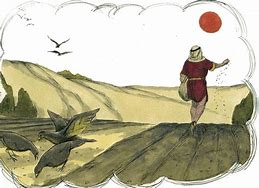 following Jesus Christ lightly. He wants to weed out the superficial, light-hearted people who have no real interest in following Christ to the end. He wants to prevent people from coming, who are like that second soil in the Parable of the Sower – who have no root in themselves, and when persecution or trials come, they are offended and wither away. Now you may say, ‘But who on earth is this way? Who loves Christ supremely? Who follows Him single-mindedly? Who holds the world so loosely? Who can possibly keep this standard?’ Though a true believer will have these attitudes at conversion, they will not become perfect actions but by a process of instruction and growth. For this they need discipleship. Being a disciple requires discipleship.
 take up his cross daily, and follow Me. For whoever desires to save his life will lose it, but whoever loses his life for My sake will save it. For what profit is it to a man if he gains the whole world, and is himself destroyed or lost?”
 Jesus illustrated it this way: “Verily, verily, I say unto you, Except a corn of wheat fall into the ground and die, it abideth alone: but if it die, it bringeth forth much fruit” – John 12:24. A disciple does not simply use Jesus as Saviour; a disciple follows Jesus as Lord. A disciple follows because he or she wants to imitate their master. We want to imbibe His Spirit and imitate His example.
 down – ‘You want to follow Me, do you?’ Is it just the buzz of the crowd? Is it just the excitement of a new thing, a fad? Is it for what you can get out of Me? This is what it means to really follow Me – to love me Supremely, to follow Me Single-mindedly, and to forsake all you have. I can picture the crowd thinning out. Now again, does Jesus mean that in order to follow Him, you must sell or give away everything you own? It does not normally mean that, though God does call some to do that.
 better – it is Him. A disciple of Jesus Christ does not love anything or anyone more than Jesus Christ. Not other people. Not popularity. Not pleasure. Not money. Not success. Not good looks. Not material possessions. A disciple loves Christ supremely.
 Psalm 73:25 – Whom have I in heaven but thee? and there is none upon earth that I desire beside thee.
 himself’, added in. What does this mean? Some have taken this to mean Jesus wants us to carry a wooden beam around, and you have had people literally walking around with crosses. But that is not what Jesus meant here.
 The word ‘Christian’ (in the singular or plural form) appears only three times. The word ‘believers’ appears twice. The word ‘brethren’ appears numerous times as the way believers talk about themselves, and to each other – brothers and sisters. But probably the most oft-used term to describe believers is the word ‘disciples.’ ‘Disciples of the Lord Jesus Christ’ is how the Bible describes us. Indeed, the Great Commission in Matthew 28 is not ‘Go and get professions of faith.’ It is ‘Go and make disciples.’
 The Lord teaches us this with a striking sentence. He says, ‘You cannot be my disciple unless you hate your parents, children, brothers and sisters and yourself.’ Now what does Jesus mean by this? Is He commanding malice? Is He telling us the condition of following Him is to despise others and ourselves? No, because this would contradict his own teaching. He told us to love our neighbours as ourselves. He told us in the Sermon on the Mount that as we would want others to treat us, so we ought to treat them. He even commanded us to love our enemies – which would make us like the Father. John tells us in 1 John 2:11 – “he that hateth his brother is in darkness, and walketh in darkness”.
 And perhaps, if we took it to a judge, you would be right. But you are missing the heart of being a follower of Christ. A follower of Christ is not trying to defend apathy and indifference and laziness. A follower of Christ is not trying to only get by with what is clearly mandated. A follower of Christ does not try to see how close to the world he or she can get without crossing the line.

 In 1835, George Mueller had a burning desire to take care of the orphans of England. He wrote: “I was struck in reading the Scriptures with these words, ‘Open thy mouth wide, and I will fill it.’ I was led to apply this scripture to the orphan house, and ask the Lord for premises, one thousand pounds and suitable individuals to take care of the children”. Mueller never made any public appeals for money, and never went into debt. In reviewing that year’s work, he found that God had given him his first orphanage house on Wilson Street, and seven months after the opening of the first house, he obtained another one located at No. 1 Wilson Street. A review of his financial returns showed gifts for the orphanages of seven hundred and seventy pounds, and he himself had received for his personal needs two hundred and thirty two pounds – coming to one thousand and two pounds.
 When you go beyond obligation, you will find it. You will see God calling you to do more than greet your neighbour, but witness to them. You will see God calling you to do more than attend a church, but to serve in it. You will see God
 their walk with God. This is how minimal obedience thinks: ‘What is the least amount of effort I can put into my Christian life and still be OK? How can I do as much as I want to do, and as little as God wants me to do without God getting upset with me and making things go bad for me?’
 about to be betrayed into the hands of men, 23 and they will kill Him, and the third day He will be raised up.” And they were exceedingly sorrowful. 24 When they had come to Capernaum those who received the temple tax came to Peter and said, “Does your Teacher not pay the temple tax?”25 He said, “Yes.”And when he had come into the house, Jesus anticipated him, saying, “What do you think, Simon? From whom do the kings of the earth take customs or taxes, from their sons or from strangers?” 26 Peter said to Him, “From strangers.”Jesus said to him, “Then the sons are free. 27 Nevertheless, lest we offend them, go to the sea, cast in a hook, and take the fish that comes up first. And when you have opened its mouth, you will find a piece of money, take that and give it to them for Me and you.” – Matthew 17:14-27
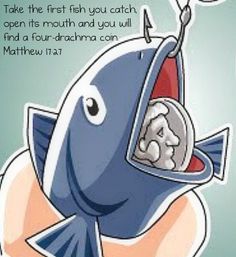 those days, the royal families were tax exempt. And Peter says, ‘From strangers.’ Jesus says, ‘Well then, the children are free – the children are exempt from the tax. They do not have to pay it. They are not under obligation.’ Who does the Temple belong to? As it were, who is the King of the Temple? God is. Would you tax God to maintain His temple? No. Who is God’s Son? Jesus. Do you tax the Prince to maintain His temple? No. Jesus is exempt. Jesus does not have to pay the Temple tax, because of His identity. His status as God’s Son means He does not have to obey the Law in Exodus 30. So Jesus is also gently correcting Peter’s impulsive answer. Peter isn’t completely wrong – for Jesus does pay, but not for the reasons others pay. But, says Jesus, ‘Lest we should offend them – go and fish, and the first fish you catch will have money for your tax and mine, and go and pay them.’ So here you see the first principle of truly obeying God.
 Christians. If that is you, then you must structure things so as to interact with unbelievers. I would firstly say, make sure you pray for opportunities to witness.
 Try to be consistent – after supper on as many days as you can, or just after breakfast on as many days as you can. Just like your own times of devotion – you can vary the elements, but the point is to have a heart for God together. The point is to have a love for God as a family – not as individuals going their own way.
 for thirty minutes. Do not think that eating anything is a sign of spirituality. Just because you are a Baptist, does not mean that gluttony is allowed. Food is one area where we sometimes have to deny ourselves something quite lawful to maintain the atmosphere of self-discipline. Continual indulgence in one area, makes it more likely in all other areas.