Covid19 Lessons From Job

“Covid-19” is a term that we all know too well. This virus has spread throughout every country and   like a surreal science-fiction movie has resulted in a massive world-wide crisis with many infections, death and drastic government policies that have closed down the world physically and economically.

At the beginning of April 2020 there were over 1.2-million infections, 65,000 deaths and what is shocking is that all this happened in a very short period of time, just a few months.

Epidemiologists say we have not reached the peak of infections in many countries around the world, the worst for some places in the world is still to come.

What this pandemic shows is global human uncertainty. There are so many unknowns and differing opinions that it is not surprising then that people in many parts of the world live in anxiousness and fear.

The loss of life in this pandemic is tragic for any family and we can never minimize that sorrow- but, there is also anxiety from loss of jobs, business shutdowns, leaving an uncertain future ahead for many people. Christians are affected just like anyone else.

Many in these crisis times people ask questions, questions like: Why this? Why now? Why so severe? Why me?  Why not someone else?

When this happens we ask questions of God – and who He is,  and the nature of his being. We bring God down and place Him in the dock, and we demand an explanation. And for some God is tried and tested and found lacking, and some teeter on the precipice of apostasy.

It is also in times of crisis and suffering that people, even Christians, can face the same condemnation as Job’s friends – received from God because Christians are “not speaking what was right.”

Can this not be a better time to study the certaintly of the Word of God. And particularly the Book of Job. I would encourage you to read ahead as we take on this study on Sunday evenings.

And we have to approach this Book about suffering with great humility, realizing that we may not know the specific answers to specific cases of tragedy.

Yet, the prologue of Job in chapter 1 and 2 is for our benefit.

The book carries his Job’s name, but Job was not part of these celestial dialogues of God. He knows nothing of this great Palace appointment between God and Satan.

But we are given prime seating in God’s Palace – to look behind the scenes, and get glimpse through the haze and mists of how God providentially works in the Universe, specifically in the terrible suffering in one particular individual’s life.

I am thankful that Matt skillfully covered the introduction and verses 1-5 of Chapter 1 – last week – and I would encourage you to listen to that excellent exposition on Job the Man.

Now Verses 6-12 suddenly change the scene. They now “beam us up” and take us into the Palace of God. Here the central purpose is to make us observers of an important celestial conversation between God and Satan.

As we step into the throne room of God, into his Providential Palace – before we take our seats and witness the divine proceedings – let us hang our hats on four pegs – and call them 4 Covid19 Lessons From Job

Lesson 1.God’s Sovereignty  (6)          

Lesson 2.God’s Electing Grace           (7,8)        

Lesson 3.Satan’s Opposition (9-11)      

Lesson 4. God’s Permission   (12)  

  1. LESSON1 – GODS SOVERIGNITY (verse 6)

6 Now there was a day when the sons of God came to present themselves before the Lord, and Satan also came among them.

The Palace Room

Imagine receiving an invitation by a Supreme King – to come to his Palace and be part of one of his lavish and spectacular councils.

You will get to sit in the best of seats as you witness many dignitaries of great power and status coming before this King to present themselves, and seek His counsel. It is an awesome and terrifying sight. Soon you realize you will be privy to secret Divine Decrees that will affect the rest of one individuals life!

We cannot fail to recognize the importance of this heavenly Palace, it really is the key to comprehending the Book of Job.

Then  as we sit in our prime seats and observe the proceeding at Palace of God – we see another being singled out as entering the presence of God.  

Your text might say and “Satan came among them.” OR “Satan also came among them.”

It seems to be a normal occurrence for Satan to come among the sons of God.

In the original It says – “and the Satan also came among them.” There is a definite article before the word Satan.

The term “the satan” means “the adversary.”

You can see this sense in Numbers 22:22 in the story of Balaams donkey.

“But God was angry because he was going, and the angel of the Lord took his stand in the way as an adversary (the word – satan) against him.

1 Kings 11:25 tells us that Rezon was Israel’s adversary (satan) through the life of Solomon.

         In Psalm 109:6 it takes on an additional meaning  – it says

              “ 6 Appoint a wicked man over him,

              And let an accuser stand at his right hand.”

    “Accuser” is the word SATAN.

    So “the satan” means “the adversary”, “the accuser,” “the prosecuting attorney”.

But obviously in this text it is not only talking about a beings role here.

“the Satan” is a particular evil being who has personhood, who thinks and talks and communicates with God.

 In other texts of the OT for example in Zechariah 3:1-2 the celestial being, the personal being Satan is referred to, your text may have a capital “S” reflecting this.

  1. Then he showed me Joshua the high priest standing before the angel of the Lord, and Satan standing at his right hand to accuse him. 2 The Lord said to Satan, “The Lord rebuke you, Satan! Indeed, the Lord who has chosen Jerusalem rebuke you! Is this not a brand plucked from the fire?”

This is also the case in 1 Chron 21:1

           “  1Then Satan stood up against Israel and moved David to number Israel.”

Now as we read through Job Chapter 1 and 2 you see that “the Satan” does not simply function as the accuser, exposing human failings – but, in addition he goes out and he also afflicts Job and seeks to turn him against God as well, this is very typical of Satan’s character and actions in the New Testament as well.

AND SO in our Text – Verse 6 says – and “THE SATAN” also came among them – This then I would take to refer to Satan himself.

The same one who headed the revolt in heaven against the authority of God (Rev. 12:7–9), seduced Adam and Eve into sin (Gen. 3:1–6; 2 Cor. 11:3), tempted Jesus Christ (Matt. 4:1), warred against him throughout his entire career on earth (Matt. 13:39; Luke 10:18; John 12:31), who rules in the children of disobedience as the prince of the power of the air (Eph. 2:2), and fights against the children of light (Eph. 6:11–16).

From this Palace room we see that it is supernatural evil – is very real and evil does have a bearing on God’s providence and how this is experienced in suffering in Job’s life. Yet throughout Job the ultimate appeals against suffering are never made to Satan but brought before God himself.

In this Palace we see God is supreme over all of the events of the universe, and even Satan has to present himself just as all the other beings are required to as do and Satan like the other “sons of God”  is totally subject to God.

God is there, the angelic hosts are there and Satan is there.

Ironically, one critical person is missing – that is Job himself, and this is the key to the book of Job.

Job is not given the seats we are given. The person after whom this book it titled is not privy to one of the most important meetings in God’s Palace that will affect the rest of his life.

Humbly we have to realize that this is so often the case in our own personal suffering. We like Job are not given direct access to the counsels of God as to why in a particular case or a particular season we go through terrible suffering.

The issue is not that Yahweh does not know Job, or that the Sovereign Ruler does not know the beginning from the end. God is omniscient. The issue is what Job the sufferer does not know, and what God wants him to learn through experience, and through his unanswered questions – Job will live by faith and that faith will sustain Job through the worst of suffering.

Here is another observation. From the prime seats in God’s palace that day we can also see how the Universe is governed.

We are not introduced to a celestial council of the “gods.”

In other words – the world is not governed by multiple gods and goddesses. There are not random spirits who are rather fickle and have sinful human desires and natures and who have to be constantly appeased by us in order to be friendly. Many false pagan religions teach this, but this is not what we see here.

In Job and the Bible we see that God HIMSELF is not a fickle being with absolute power. But He always operates consistently in accordance with His Holy character. He is described as Good and Just and Righteous and Holy. Evil and sin can never be attributed to Him.

Secondly, we are also not presented with a council where two massive opposing and equal powers are sizing each OTHER UP for a contest.

The universe we live in – is not a dualistic universe.

Sadly, many Christians though they may no say they believe in God, live fearfully in the world – a Covid19 world – of random chance, unsure which force – good or evil – will win out at any point in time in their lives.

But Dualism does not exist here in Job.  There is one sovereign and supreme God and he remains in control.

Satan is the evil accuser and the terrible adversary but he must present himself in the Palace council. In the verses to follow it is clear he has no autonomy apart from the commands and boundaries that God himself sets (1:12; 2:6).

But Let me say even though there is not dualism – we still realize from verse 6 – that we don’t just simply operate in a visible material world.

There lies another significant world filled with angelic beings whose actions are encompassed in the Providence of God for his own purposes. We see that God will use a multiplicity of created beings, some of whom are indeed evil, to achieve His good and gracious purposes in the world and in His people

And in that celestial world which there is  “one” Jesus calls “the ruler of this world” (John 12:31) and whom Paul will later call “the prince of the power of the air, the spirit that is now at work in the sons of disobedience” (Ephesians 2:2), the “god of this age” (2 Cor 4:4), blinding the minds of unbelievers (2Cor 4:4).

And it would be right to fear Satan if we did not know an immovable restraint has been placed on him which prevents him from doing what he would like to do.

So in summary the first foundational pillar of God’s Providence is to know that God is supremely in control of the circumstances and events of our lives.

The second Lesson is God’s grace, His electing grace.
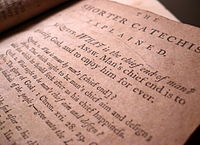
The Great Priority

Loving God is the priority of the Christian life. Are you familiar with the overarching goal of the Christian life? What is the Christian life really about? What is the big idea? Use this study to grow your understanding of the primacy of worship, of God’s glory and of knowing and loving Him. You will begin to relate all you do back to this main priority.

Memorize Mark 12:30 – ” And you shall love the Lord your God with all your heart and with all your soul and with all your mind and with all your strength”

Questions and Answers

Question 1: What is the great priority and purpose of man? Man’s great priority and purpose is to love God with his entire being: heart, soul, mind and strength (Mk 12:29­ 30).

Question 2: Why is this man’s great priority and purpose? Loving with the entire being is worship: expressing the worth and value due to God (Ps 29:1­2). Man was created to express this glory (Is 43:7), as image bearers (Gen 1:26-­28), just as the entire created order is to reflect and magnify the worth of God (Ps 148-­149; Revelation 4:11).

Question 3: Why should all creatures magnify God’s worth? God is Beauty (Job 40:9-­10). The Triune God is the perfection of all excellence in Being, the quintessence of truth and goodness. This glory calls for the appropriate response of highest enjoyment and admiration (Ps 113:3, Jer 10:7).

Question 4: Why should God delight in this worship? God delights in His own glory above all things, knowing that the magnification of His glory is the greater good of all (Ps 33:1; Ps 147:1).


Question 5: Why should man delight in this worship? Nothing is more reasonable, and nothing is more profitable than for man to love what is most beautiful (Jo 15:11, 17:13, 24; Ps 73:25)

Question 6: What is meant by loving God with one’s entire being? To love God with the entire being is to love Him for Himself, not as a means to a higher love, but to delight in Him ultimately, reflect Him completely and magnify Him fully (Ps 73:25­26).

Question 7: Why should God not be loved as a means to another end? God is the only God, the only One worthy of ultimate love (Ps 115:1) and not an instrument to some other love, for all things are from Him, and through Him, and to Him (Rom 11:36).

Question 8: May we love anything or anyone besides God? Ultimate love for God demands that we love only that which God loves, for His sake (Matthew 10:37). Nothing or no one else should be loved as an end.

Question 9: What kind of love should we give to God? Our love for God should correspond to His supremacy and His holy nature: ultimate love, with ordinate affection (Mal 1:6,11).

Question 10: What is ordinate affection? Ordinate affection is holy desire for God that corresponds in intention and expressions with God’s nature (Phil 1:9-­10, Ps 97:10).

Question 11: What is the danger of loving God wrongly? Our hearts may deceive us into loving a god in our own image, or rejoicing in our own feelings (Ps 50:21, Rev 2:1­5).

Question 12: Is this love a work of our own human effort? No, God’s own love for Himself is first imputed to us when we are saved (justification), and then progressively imparted to us (sanctification) (Jo 17:26, 14:23; Ro 5:5; 1 Jo. 4:19).

Question 13: How can we love God in an ordinate way? We love Him rightly when we know Him truly. God must graciously reveal Himself to us (Mt. 11:25-­27; 1 Jo 4:19), and then teach and enable our hearts to respond appropriately to Him. (Ps 34:11; Phil 1:9-­11; Heb 5:14).

Question 14: How does God graciously reveal Himself? God reveals Himself by revealing His presence to his people through the illumination of the Spirit (Eph 3:16­ 19).


Question 15: How is God’s presence revealed in the new covenant? Once Christ ascended, He sent His Spirit to indwell all who are born again. Those “in Christ” will now experience “Christ in you” by the presence and work of the Spirit(Jo 14:16­23; 6:56; 17:23, 26; Gal 2:20; Eph 1:3; Col 1:27).

Question 16: What are we to do in His presence to come to love Him ordinately? Christ tells us to abide in Him. Abiding is experiential union where we behold God and love Him (Jo 15:4­5; Eph 3:16­19).

Progress Assessment and Planning for Change

What are some inappropriate ways of worshipping God? Treating worship as entertainment, offering music that is trite, common or untrue, using His name flippantly are some examples of inappropriate worship. How do we learn to love God appropriately? Write down a description of your love for God at present – keeping these points in mind.. All the disciplines of the Christian life – obedience, prayer, meditation, fellowship, service, giving, evangelising, and many others are aimed at knowing God, so as to love Him, and thereby magnify His value to others.

Name the disciplines where you know you could improve. Choose one of these and give details of how you will strive to grow this area of your Christian walk. Share this with one another person. Go through Mark 12:30 together. Clarify the meaning and its application. Make every effort to memorise it together before leaving the session. Scripture memorisation

Helpful resources

Desiring God ­ John Piper
On Loving God ­ Bernard of Clairvaux
The Four Loves ­ C.S. Lewis
How to Worship Jesus Christ ­ Joseph Carrol
God’s Passion for His Glory ­ Jonathan Edwards/ John Piper
The Pursuit of God ­ A.W. Tozer

– David De Bruyn, Professor of Church History, Shepherds’ Seminary Africa

Conscience, Part III

The whole Christian life is to be love for God from a pure and sincere heart out of a good conscience. The conscience watches and afflicts us. The conscience is informed by our sources of moral information and by our actions. A clear conscience is necessary to have boldness before God and man. So, in light of all this, how does God tell us to clear our consciences? What does the Bible tell us to do to have pure and clean consciences before Him?

IV. The Clearing of the Conscience

1) Stop ignoring it. Your conscience is there for a reason, and it is not meant to be ignored. Generally speaking, you should not violate your conscience. That is much of the point of Romans 14 and I Corinthians chapters 8 to 10. If you have come to a belief about something using the Word of God, then you must keep to that conviction before the Lord, unless the Word persuades you otherwise. And as we live amongst each

other, we must treat each other’s consciences very carefully, not despising each other’s convictions, nor treading all over one another’s consciences with our own actions. Let every man be fully persuaded in his own mind – using the Word of God. Whether it is right or wrong, it does you no good to ignore the alarm. If your alarm goes off at home, there is either an intruder in the house, or there is a fault in the alarm. But it won’t do you any good to just throw a brick at the siren. It is the same with your conscience – either there is a sin, which needs to be confessed, or the conscience is faulty and needs to be conformed to God’s Word. Ignoring your conscience produces problems of its own. If you ignore your conscience, you begin to think you can sin without consequence. You begin to think that you can obey God in spurts, in stops and starts, and it won’t hurt if you take a break from obeying Him here and there, now and then. You become expert at all kinds of schemes – minimising, blaming, distracting, excuse-making, covering etc. These only decrease the light and further adjust the conscience.

2) Compare your conscience’s judgement with the Word of God. If your conscience is alarmed, it is alarmed because it believes you have failed to do right. You then must compare its judgement with God’s judgement. Psalm 119:11 – Your word I have hidden in my heart, That I might not sin against You! If your conscience is wrong, then you must inform it with the Word. You can tell it that it is a false alarm, and it needs to settle down. 1 John 3:20 – For if our heart condemns us, God is greater than our heart, and knows all things. Furthermore, you need to keep informing your conscience with the Word of God so that it does go off

when it should. This is why it is so important that you are taking in the Word of God daily. This is why it is important that you are with believers every time we meet to open the Word together, so that your conscience can receive the light it needs to correctly judge your actions. If God has said it is a sin to do this or to fail to do that, then you must agree with God and your conscience.

3) If you have sinned, confess and forsake it. Proverbs 28:13 – He who covers his sins will not prosper, But whoever confesses and forsakes them will have mercy. Confession is very simple. It is pleading guilty before God. It is agreeing with His verdict on your actions. The Word of God, by the Spirit of God, through your conscience, accuses, and you agree with Him. You agree with Him as one turning away from the sin. It does no good to agree that something is a sin and continue on in it. There must be a genuine desire to stop. Now there are two reasons why you can confess your sins and expect your conscience to be calm. Firstly, God has provided a blood sacrifice to c leanse you. Recognise that blood alone can cleanse sin, not self-effort, not discipline, not sincerity. Hebrews 9:12-14 – Not with the blood of goats and calves, but with His own blood He entered the Most Holy Place once for all, having obtained eternal redemption. For if the blood of bulls and goats and the ashes of a heifer, sprinkling the unclean, sanctifies for the purifying of the flesh, how much more shall the blood of Christ, who through the eternal Spirit offered Himself without spot to God, cleanse your conscience from dead works to serve the living God Secondly, God delights to show mercy to sinners who repent. Micah 7:18 – Who is a God like You, Pardoning iniquity And passing over the transgression of the remnant of His heritage? He does not retain His anger forever, Because He delights in mercy. If God hated to show mercy, what motive would there be in coming to Him? The fact that He delights to forgive means that you please Him when you confess your sin. Confessing your sin does not displease God; it pleases Him. The sin is what displeases Him, but refusing to confess only makes matters worse. Because God has provided the means for your cleansing from sin, and delights to continue to forgive, we must confess our sins as often as we become aware of them. We must confess our sins as often as we need to. 1 John 1:9 – If we confess our sins, He is faithful and just to forgive us our sins and to cleanse us from all unrighteousness.


Repeated confession is not an abuse of grace if you are trying to please God. This is what happens with a sin we are struggling with. We start out by obeying I John 1:9. We sin again. We confess our sins. But after a few times, we begin to think – I am abusing I John 1:9. I can’t just keep sinning and confessing. This is abusing the grace of God. So instead of confessing, we don’t confess, somehow thinking we are better off if we don’t. But in the meantime, we are hardening ourselves to the cries of our conscience, displeasing the Lord, and living with the fear and lack of boldness that comes from doing so. Here is the truth – the only time I John 1:9 is abused is in the mind of someone who uses it as an excuse to sin again. It is not abused by a person who has sinned again, and needs it. It is not abused by a person who has sinned again and genuinely confesses it with a view to forsaking it. If you are in a pattern of sin, where right now it is like climbing a muddy mountain, and almost every step is a slip, then I John 1:9 is there as often as you need it. There is no limit on how many times God forgives the one who genuinely confesses. He forgives when He knows you will fall again. He forgives knowing how long you will struggle with this sin. But in the meantime – you keep confessing. Because, while you do so – you are keeping your conscience in tune with the Word of God. You are remaining filled with the Spirit. What that will mean is all the likelihood that you will sin in that area less. So it might be 1000 times of I John 1:9 today. Tomorrow it might be 945 and the following day 897. But keep coming back to the blood of Christ. It is there to cleanse you. Not once a day, but over and over and over again. God delights to forgive you. He wants to cleanse you.

There is a Fountain Filled With Blood
Drawn From Immanuel’s Veins
And Sinners Plunged Beneath its flood
Lose all their guilty stains.


4) Walk in the light of forgiveness. If you confess your sins, God makes a promise. Now, once God has made us a promise, what does He want us to do with that promise? He wants us to regard it as true, and act and think like it. Picture that thief on the cross. He called on Jesus to have mercy on Him. Jesus said, “Today you will be with me in paradise.” What if he had responded, “How can I know that? How can I be sure? I don’t feel forgiven. Besides, how can I be saved in my last moments when I have lived my whole life for self? If we weren’t on these crosses, I wouldn’t even have come to you, Jesus. I can’t really be sincere. I don’t see how you could forgive someone like me.” What word would you have used to describe the man’s attitude? Humility? Sincerity? Unbelief. If God has said he will forgive repentant sinners, we honour Him by believing His Word. Like a master will say to a well-trained dog – ‘settle down’ and it will stop

barking, so the Holy Spirit can say to our consciences, settle down. We can say to our own consciences, settle down. The sin has been found, and dealt with. One pastor said that some people would come to him and say, ‘I confess the same sin a thousand times’. He would respond, you should confess it once, and then thank God a thousand times for forgiving you. Your conscience is a precious thing. You ought to live in light of it. You can’t get rid of it. But you can harm it and abuse it. Instead, you have to expose it to the Word of God, agree with God where there is sin, confess and forsake it, and then rest in that forgiveness. We need our boldness back. Boldness in witness, boldness in ministry. It will only come back with a clear conscience.


– David De Bruyn, Professor of Church History, Shepherds’ Seminary Africa


Conscience, Part II

III. The Importance of the Conscience

There is a profoundly important reason why every Christian should seek to have a clear conscience before God and man. It is simply this: a guilty conscience destroys boldness – Proverbs 28:1, The wicked flee when no one pursues, But the righteous are bold as a lion. A guilty conscience causes people to feel shame, and the result of shame is a lack of boldness before God and before man. Think back to Adam and Eve. The moment their consciences were sounding the alarm bells, they

hid. They hid from God. When our consciences are bothering us, we usually do not approach God, we avoid prayer, we avoid the Word, and we may avoid fellowship with other Christians. Or think of how Jesus described the actions of the guilty towards the light: John 3:19-20 – And this is the condemnation, that the light has come into the world, and men loved darkness rather than light, because their deeds were evil. For everyone practicing evil hates the light and does not come to the light, lest his deeds should be exposed.

A guilty conscience robs us of boldness before God. A clear conscience on the other hand, gives us confidence before God: 1 John 3:21 – Beloved, if our heart does not condemn us, we have confidence toward God: Hebrews 10:19-22 – Therefore, brethren, having boldness to enter the Holiest by the blood of Jesus, by a new and living way which He consecrated for us, through the veil, that is, His flesh, and having a High Priest over the house of God, let us draw near with a true heart in full assurance of faith, having our hearts sprinkled from an evil conscience and our bodies washed with pure water. When you are uncomfortable in the presence of God, when you struggle to be quiet before Him, when you are restless and edgy in prayer; look to see if your conscience is not sounding an alarm. Not only does a guilty conscience rob us of boldness before God, it robs us of boldness before men. One of the reasons why so few men have any moral boldness any longer is because their consciences shame them into silence. They are filled with guilt over their greed, their laziness, their neglect of their homes, their pornography, their lust, their spiritual sloth, that they can barely maintain eye-contact with other men, let alone lead.

They will not rebuke sin in another person when they see it, for they are walking around with un-confessed sin themselves. There is a beam in their own eye; they know they must remove it before dealing with the speck in another’s. But rather than dealing with the beam, like Jesus told us to, they live with it, and simply avoid helping others with their specks. That is why there is so little one-on-one rebuke, admonition and encouragement, because men have become spiritual jellyfish due to their guilty consciences. Paul says in Galatians 6 that it is to be those who are spiritual that are to restore those overcome in a sin. The problem is, there are so many overcome with a sin, and remaining there, that few are bold  enough to help others out of theirs. The same is true of evangelism. The reason why so few speak up for the name of Jesus, why so few boldly tell others about Jesus, is because they are ashamed. Not necessarily of Jesus; they are ashamed to name Jesus because of their un-confessed sin. Romans 1:16 – they are ashamed to bring a message of repentance to others when they know they are not responding to the calls to repent from their own conscience. Peter tells us we are to be able to speak to others with a clear conscience:  1 Peter 3:15-16 – But sanctify the Lord God in your hearts, and always be ready to give a defense to everyone who asks you a reason for the hope that is in you, with meekness and fear; having a good conscience, that when they
defame you as evildoers, those who revile your good conduct in Christ may be ashamed.

Consider Paul’s testimony:

Acts 24:16 – This being so, I myself always strive to have a conscience without offense toward God and men; 2 Timothy 1:3 – I thank God, whom I serve with a pure conscience, as my forefathers did, as without ceasing I
remember you in my prayers night and day; 2 Corinthians 1:12 – For our boasting is this: the testimony of our conscience that we conducted ourselves in the world in simplicity and godly sincerity, not with fleshly wisdom but by the grace of God, and more abundantly toward you.
What would be the difference in our individual walks with God if we had clear consciences? How would it change our prayer life, our devotions? How would it change our boldness to disciple one another, to correct our children, to call sin what it is? How would it change our witness and
evangelism? 

1 Timothy 1:5 – Now the purpose of the commandment is love from a pure heart, from a good conscience, and from sincere faith. The whole Christian life is to be love for God from a pure and sincere heart out of a good conscience. The conscience watches and afflicts us. The conscience is informed by our sources of moral information and by our actions. A clear conscience is necessary to have boldness before God and man. So, in light of all this, how does God tell us to clear our consciences? What does the Bible tell us to do to have pure and clean consciences before Him?

  – David De Bruyn, Professor of Church History, Shepherds’ Seminary Africa

Biblical Principles For Voting

A Guide for South African Christians for the 2019 Elections

A pastor, a church or even an association of churches has no business proclaiming one political party to be a better choice than another, or instructing Christians to vote for one over the other. The separation of church and state means that the church can never be an arm or an ally of an entity seeking political power.  However, the church does have a role to play: to teach Christian disciples the biblical principles that you have to apply when voting. Voting, like every act a human being performs, is an act of a moral being, and it has moral value. For that reason, a Christian should want to know how to vote in a way that will please God. Once you know that, you’ll have to do your homework to find out which candidates or parties meet the biblical standards.

The Bible lays certain obligations on all human governments. These are the things God expects a government to do, regardless of their religious beliefs. Any political party that refuses or neglects to do these things is disobeying God, and a vote to support them is essentially a Christian ignoring his or her Father’s explicit will for human government. When Christians vote, they are exercising a right given to citizens of a democratic state: they are requesting certain persons to be their government. And since Christians answer to God first, their vote must represent a request for a government that obeys God’s mandate for human government.

So what does God expect from human government?

1) Government Should Protect Human Life

At the very institution of human government, God gave human beings the mandate to protect humans, because they are made in the image of God (Gen 9:6). Governments are to protect the most precious thing on earth: human life. This protection of the right to life extends to the unborn, and any party that refuses to end the holocaust of abortion does not take seriously the protection of human life (Proverbs 24:11-12). A just government will take seriously all threats to the lives of its citizenry, be they criminal threats, aggressive nations, or even industries or businesses that irresponsibly put human life at risk. Indeed, a righteous and fair government will be willing to protect life at the cost of life.

2) Government Should Display Integrity of Dealings

God requires that those who rule over men are not to be controlled by covetousness, with the inevitable bribery, perverting of justice and partiality that follows coveting. “He who rules over men must be just, ruling in the fear of God.” (2 Sam 23:3). “Moreover you shall select from all the people able men, such as fear God, men of truth, hating covetousness” (Exodus 18:21). Rulers, regardless of their personal religious beliefs, are to exercise integrity and impartiality for the sake of their office (Proverbs 16:12; 28:15-16; 29:2, 4, 12, 14).

3) Government Should Restrain Evildoers and Uphold the Law

Augustine said that government is a necessary evil, that it is necessary because of evil.Government is required to restrain evildoers through the administration of justice, and the upholding of the law (Rom 13:1-4). At this point, we enter into a debate over what kind of laws a government should make. Put simply, the mandate for a God-pleasing government is to legislate what will restrain those who would harm their neighbours, and make laws that create enough civil order for human beings to live “quiet and peaceable lives in all godliness” (1 Tim 2:2).

A government that upholds the law through the appointment and support of a good and effective police force, judiciary, and penal system shows a commitment to law and order. A nation where evil is punished and justice upheld will be set free to prosper on almost every other level. This is a key mandate from God to human government (Proverbs 14:34, 16:10, 17:15, 20:8, 20:26, 24:23-25, 25:5).

4) Government Must Protect Private Property

The right to private property is one of the fundamental rights of human beings, and a basis of true civil freedom. Stable families, businesses and communities depend on the economic and social stability which private property ownership brings. God Himself protects this right (Ex 20:15, 17), and consequently expects government to protect it as well. A government that seeks to undermine this right through expropriation without compensation (theft), excessive taxes, penalties, or other levies that enriches itself and penalises the private property-owner is expressing a profound injustice, and overtly or indirectly showing its contempt of the freedom of its citizens.

Notice what government is not required by God to do: support one religion over another, create jobs, manage and legislate the economy, increase the wealth of the country or the wealth of its own government, provide housing for its citizens, provide medical support or assistance to its citizens, or make sure every citizen is educated. Now, we might object that this is an argument from silence: merely because the Bible does not say government ought to do these things does not mean it should not. But that is precisely wrong! God does speak on human government in His Word, and when He does, He is prescriptive regarding what human government is to do. We dare not insist that God wills other things for human government, when God has spoken clearly as to what He expects, and what displeases Him. To say otherwise is to literally put words in God’s mouth.

Indeed, some of the things people wish government to provide are actually required of others. Paul makes it clear in 2 Thessalonians 3:10 that able-bodied human beings are responsible to earn their own living and see to their own welfare. First Timothy 5:8 makes it clear that caring for the elderly is something that falls firstly upon the family. When governments take the responsibility God gives to others, they create unhealthy expectations and foster immature dependence.

Certainly, a citizen may wish that a government provided free medical care, free education, plenty of jobs, and a competitive currency. But these are preferences of the citizen, not a mandate from God. Indeed, some would argue that when a government seeks to manage these things, it ends up hindering the country, rather than helping it. It could be that once a government is successful in doing the direct mandates of God, it may be able to promote some of the other goods such as housing and health. Regardless of your view on how involved a government ought to be in the economy, healthcare or education, you’ll have to agree that Scripture does not call on government to be the final steward for these things.

A Christian may wish that the government professed Christ, and certainly, true believers in Parliament would surely be a blessing to the country. But this is not God’s mandate to government. We are not required to vote for someone because he or she or his or her respective party claims to be Christian, nor are we required to dismiss a party that does not favour one religion over another. We are voting for a government. God is clear what a government is to do: show integrity, uphold the law, punish evil, protect life, and protect private property. When a party explicitly fails to do one of these God-given mandates, or even acts to defeat their implementation, it disqualifies itself as a contender for a God-pleasing government. Should you find a party that seems to uphold these four, you have a valid choice for your vote as a Christian.


  – David De Bruyn, Professor of Church History, Shepherds’ Seminary Africa & Sr. Pastor of New Covenant Baptist Church


Conscience – Part I

In South Africa, we are used to sirens. We hear police and ambulance sirens often enough. Many of us have security alarms in our homes, with sirens that go off when the alarm is tripped. Sirens are there to alert us of something that is wrong. God has placed something similar inside each of us. It is what the Bible calls conscience. What you do with that alarm system of your soul will have very important effects on your relationship with God, and even your relationship to other people. I would like us to study from the Scripture what the conscience is and what it does; how it is shaped, why it is so important, and how it is cleared.

I. What the Conscience Is

What is the conscience? The conscience is that part of the soul God has given you which does two things. First it watches all your actions at all times and in all places. It witnesses not only what you do (and fail to do); it witnesses what you think, what you desire, what you wish. It watches and witnesses. The second thing it does, depending on the action or thought, is afflict you. It punishes you. It disturbs you.

Romans 2:15 “…who show the work of the law written in their hearts, their conscience also bearing witness, and between themselves their thoughts accusing or else excusing them.”

Conscience is like an alarm system connected to motion sensors. Those motion sensors send out beams of light, and if you cross them, it triggers the alarm. Conscience is like that, except it is not located in just one place. It goes with you everywhere. And it watches every word, thought and deed, and when you do wrong, at least in the eyes of your conscience, it sounds the alarm.

What does that alarm feel like? It is an inward pain. It is the sense of shame, of guilt, of wrongdoing. It is as if someone is pointing a finger at us from within. Someone has blown the whistle on us. There is a siren going off inside saying, “Guilty, guilty, guilty”. You see examples of this in the Bible again and again. The very first sin – Adam and Eve hid from God. Why did they hide? They hid because their conscience convicted them.

Psalm 32:3-4 “When I kept silent, my bones grew old Through my groaning all the day long. For day and night Your hand was heavy upon me; My vitality was turned into the drought of summer. Selah”

You might remember the incident where some men brought an adulteress to Jesus, and He said to them, “He who is without sin among you, let him throw the first stone.” The Bible goes on to say in John 8:9 – “Then those who heard it, being convicted by their conscience, went out one by one, beginning with the oldest even to the last.”

Now, not only believers have a conscience. Unbelievers have a conscience too. The passage in Romans shows us that even the man in the jungle, having never seen a Bible, never heard the name of Jesus, never heard the Gospel, has a conscience. He has a moral judge in his own soul. From when children can understand very little language, they show evidence of a conscience. It is really a gift from God, to live Himself a witness in the soul of every human, so that even when exposure to His Word is limited, there is enough moral light in the human soul to know some right from wrong.

Proverbs 20:27 – “The spirit of a man is the lamp of the LORD, Searching all the inner depths of his heart.”

The conscience is a watcher and an afflicter.

II. The Adjustment of the Conscience

Now here is where we need to understand something very important about the conscience. The conscience is not perfect. By itself, conscience is not enough. The conscience can make mistakes. The conscience is in fact only as good as the knowledge to which it has been exposed. You see, conscience is literally ‘with-knowledge’. It is the knowledge of good and evil you gain from various sources that exist together with you, and which you carry around.

So how reliable is your conscience? As reliable as the knowledge of good and evil you have received. You learn about good and evil from many sources – from your parents and family, from childhood friends, from school and schoolteachers, from the culture around you and its various media, from the religion you grew up with, even from your own habits. Those have combined to shape the thinking of that little judge who sits in your heart. And if the information they gave you is not in accord with God’s Word, your conscience is going to be off.

I once had a compass that would point to magnetic north. Making the necessary adjustments for where we are on the earth, I could find where true north was. One day, I took a magnet, and made the compass needle do circles. I had my fun for a few minutes, but after that, the compass no longer pointed to magnetic north. It was useless as a compass. That is why conscience is not an infallible guide. It depends on what knowledge has informed your conscience.

One person grows up with cannibals, and feels little conscience over murder. Another person grows up with his parents never having married and feels no conscience over fornication. Another person might still feel guilty over eating meat on Friday. Another person, because of another person’s sin against them, feels guilty, even in marriage, about the marriage bed. See, conscience is a sensitive and powerful thing. And if the light with which it is shaped is not God’s Word rightly applied, it will be either an alarm that doesn’t go off when it should, or an alarm that goes off when it shouldn’t. It can be a dog that barks when no one is there; it can be a dog that sleeps when burglars are breaking in. To be effective it must be informed with light from God’s Word. It is like a sundial – if the truth of God’s Word shines on it – it will point the right way.

Not only is the conscience shaped by the knowledge we have, it is also shaped by our actions. In fact, the conscience can even be reset the more we sin. Like those motion sensors, they can be raised so as not to pick up pets. So, if you keep ignoring or violating your conscience, it will become less sensitive. It becomes like a judge whose judgements keep getting ignored, so he either stops making them, or announces them so softly that no one can hear.

1 Timothy 4:2 – “Speaking lies in hypocrisy, having their own conscience seared with a hot iron.“

2 Titus 1:15 – “To the pure all things are pure, but to those who are defiled and unbelieving nothing is pure; but even their mind and conscience are defiled.”

Ephesians 4:19 – “…who, being past feeling, have given themselves over to lewdness, to work all uncleanness with greediness.”

A seared conscience is like skin which is so scarred that it no longer has any sensation in it. The man who steals something feels guilty the first and second time. But by the twentieth time, his conscience is no longer alarmed. The immoral person feels guilty about their first violation of their own purity. But after a while, it becomes like just scratching an itch. But if you keep obeying the Word that you hear, you will sensitise and strengthen the conscience to respond to the right things at the right time.

Hebrews 5:13-14 – “For everyone who partakes only of milk is unskilled in the word of righteousness, for he is a babe. But solid food belongs to those who are of full age, that is, those who by reason of use have their senses exercised to discern both good and evil.”

  – David De Bruyn, Professor of Church History, Shepherds’ Seminary Africa

Reasons Why Some Will Not Come to Christ – Part II

3. Unbelief with Respect to the Promises of Christ

You may not be guilty of some daring, idolatrous attachment to sin. Perhaps you already have forsaken many sins, for your own good and for the sake of respectability before others. Yet there is one subtle form of sin which you have never even considered. Maybe you do not think it is very important, and certainly not very disgraceful. Perhaps you are one who does not believe Christ’s promises.

But you say, “Unbelief? What kind of sin is that? And why would God hold me responsible for not believing something?” My friend, consider for a few minutes how unbelief can be one of the greatest obstacles to coming to Christ, and thereby keep you from entering heaven.

Can there be any question that the promises of Jesus Christ are clear, certain, and all-embracing? Read this sampling of His promises. Look them up in the Bible to see for yourself how absolutely free of conditions and qualifications they are.

Matthew 11:28 – “Come to Me, all you who labor and are heavy laden, and I will give you rest.”

Romans 10:12 – “The Lord is rich to all who call upon Him.”

Romans 10:13 – “Whoever calls on the name of the Lord shall be saved.”

John 5:24 – “He who hears My word and believes in Him who sent Me has everlasting life, and shall not come into judgment, but has passed from death to life.”

John 6:37 – “The one who comes to Me I will by no means”—under no conditions whatsoever, under no circumstances—”cast out.”

God likens His work of salvation to a wedding feast and says, “All things are ready. Come to the wedding” (Matt. 22:4). God has made all the preparations, and God has done all that needs to be done. We do not need to bring anything; we only need to come.

In the light of such marvelous, unqualified promises of forgiveness and acceptance, do you see how inexcusable is the sin of unbelief? The gospel feast has been spread and God has sent His servants to say, “Come, for all things are now ready” (Luke 14:17). But you linger outside the banquet hall, lost and condemned in your unbelieving refusal to embrace the promised mercy of God. You may not be ignorant of your desperate need or impenitent for your sins, but you are unwilling to believe God’s testimony concerning the sufficiency of His Son as a redeemer for sinful men—the God who spoke audibly from heaven, “This is My beloved Son; hear Him” (Mark 9:7).

There will be many surprising kinds of sinners in heaven. There will be notorious sinners like the immoral woman of Luke 7 whose reputation was known by all. There will be desperate sinners like the thief whose crimes warranted crucifixion. There will be murderers and blasphemers in heaven like Saul of Tarsus, and even some people whose hands put to death the Son of God (Acts 2:23). But there will be one type of sinner who will be conspicuously absent: there will be no unbelievers. There will be no persons in heaven who in this life were not joined by faith to Jesus Christ.

The Book of the Revelation paints many pictures of God’s final judgment of mankind. Many of these images are puzzling and mysterious, but look at one very clear picture of those standing outside the gates of heaven. Revelation 21:8 says, “But the cowardly, unbelieving, abominable, murderers, sexually immoral, sorcerers, idolaters, and all liars shall have their part in the lake which burns with fire and brimstone, which is the second death.” Those whose lives were respectable and even upright, but marked by the chronic sin of unbelief, shall take their eternal place with those whose lives were characterized by murder, lying and other grosser forms of sin.

We are tempted to view unbelief as a defect, or a sort of “vitamin deficiency” that leaves us spiritually anemic but really not so bad overall. God views unbelief in its true light. When Jesus describes the Holy Spirit’s purpose in coming to convict the world of sin, here is the principal sin which He highlights: “Because they do not believe in Me” (John 16:9).

If until now you have been unbelieving, will you turn from this sin and cling by faith to Christ? Will you believe His abundant promises of salvation, pardon and rest?

4. Unwarranted Expectation of Additional Revelation from Christ

Perhaps we have not yet identified your reason for waiting to come to Christ. You feel your need and you are ready to leave your sins. You are seeking to put your faith in Jesus at the right time, but you want some additional word from Him.

Your exposure to the Bible, whether through personal reading, family training, or church attendance, has taught you an important truth. You know that unless you are one of God’s elect, one of God’s special chosen ones, you cannot come to Christ. God must awaken a sinner to his need, God must draw him to Himself, and God must give him the gift of faith. And so, you reason, “Until I know that I am one of God’s elect, it would be presumptuous for me to come to Christ.”

With this conviction firmly in hand, then, you have determined that you cannot act until some additional revelation comes from Christ. You would not demand a vision or a voice in the night, of course, but you are waiting either for some special text which fixes itself on your mind, or some overwhelming sense of God’s convicting presence, or some evidence of the marks of regeneration in your life. And so, you will not come to Christ because you are waiting for a message from God.

Why is it unwarranted to expect such additional revelation? The passage in John 5 gives us a compelling answer to that question. Jesus asserted that, to the Jews, the Old Testament Scriptures should be the final, convincing proof of His claims. He said in verse 39, “You search the Scriptures, for in them you think you have eternal life; and these are they which testify of Me.” In verse 46 he says, “If you believed Moses, you would believe Me; for he wrote about Me.” In other words, Jesus is saying, “What the Scriptures say about Me, from the earliest writings of Moses through the closing words of the last prophets, is all the warrant you need to come to Me. You should not wait for something else; these words are sufficient.”

The dialogue with the rich man in hell further reinforces Jesus’ teaching on the sufficiency and finality of the scriptural witness. To the rich man’s plea that someone warn his brothers about the torments of hell, Abraham responds, “They have Moses and the prophets; let them hear them” (Luke 16:29). The rich man, though, has a better scheme: “No, father Abraham; but if one goes to them from the dead, they will repent” (v. 30). We hear the voice of Christ speaking in the final answer of Abraham: “If they do not hear Moses and the prophets, neither will they be persuaded though one rise from the dead.”

Are you waiting for some spectacular revelation from God before you will come to Christ? Are you ignoring the message of “Moses and the prophets” which you have in your Bible? Do you see that such waiting is inexcusable? Do not think that your attitude is humble submission before God. Your reluctance is actually a proud and arrogant demand upon God, telling Him how He ought to act. In effect you are saying with the rich man, “God, I have a better plan of salvation than your ordinary methods. I have a special way for you to call me, and I’m waiting for this special revelation.” The truth is, God’s plan of salvation has been presented plainly and simply to you through the witness of the Scriptures. The wedding feast of the gospel has been spread, and God invites you to have eternal life. All you need to do is come.

Is Jesus Christ calling to you? Do you see yourself, not as a special sinner, but as a needy, lost, hell-deserving sinner? Then come to Him in repentance and faith. Look upon Christ as the perfectly suitable “friend of sinners.” See how His perfectly righteous life fully satisfies the requirements of divine law. Consider how His substitutionary death fully satisfies divine justice for your sins. Do not make complicated what God has made beautifully simple; just come. Come to Christ because of God’s gracious directive: “This is His commandment: that we should believe on the name of His Son Jesus Christ” (1 John 3:23). Come to Christ because of God’s gracious promise: “Whoever believes in Him will not perish but have everlasting life” (John 3:16). May you this day put aside any reasons that stop you. Come to Christ, that you may have life.

Just as I am, without one plea
But that thy blood was shed for me,
And that thou bidd’st me come to thee,
O Lamb of God, I come.

Just as I am, and waiting not
To rid my soul of one dark blot,
To thee, whose blood can cleanse each spot,
O Lamb of God, I come.

Just as I am! Thou wilt receive,
Wilt welcome, pardon, cleanse, relieve,
Because thy promise I believe,
O Lamb of God, I come.

Albert N. Martin

Reasons Why Some Will Not Come to Christ – Part I

Jerusalem was buzzing with activity during one of the high Jewish feast days. And now at the pool of Bethesda the controversial young Rabbi from Galilee had astounded everyone by healing a man paralyzed for thirty-eight years! But instead of rejoicing, the Jewish leaders first confronted the healed man for carrying his bed on the Sabbath—this was work, they said, and God had forbidden all work on the Sabbath—and then condemned Jesus for His “work” of healing on the Sabbath day! Chapter Five of the Gospel of John records Jesus’ simple response: “My Father has been working until now, and I have been working.” This response the Jews understood as nothing less than Jesus “making himself equal with God” (John 5:18).

His plain claims to equality with God stirred up murder in the hearts of those envious Jewish leaders, yet Jesus graciously affirmed His heart’s desire for them when He declared in verse 34, “I say these things that you may be saved.” And since they could not be saved unless they believed on Him as God in the flesh and their promised Messiah, He showed them that His claims to deity were validated by three kinds of evidence, not unfamiliar to any of them: the testimony of John the Baptist, the miraculous works which Jesus had done, and the Scriptures themselves. But in spite of all this evidence, their persistent unbelief called forth from Jesus these words recorded in verse 40:

“And you will not come to me, that you may have life. “

Surely these are some of the most tragic words ever spoken! In them Jesus plainly asserted that life was to be found in Him, and that it was to be obtained simply by coming to Him. He was not speaking of physical life or physical coming, for his hearers had already come near Him physically, but of spiritual and eternal life received by joining themselves to Him through faith. Yet His hearers refused to do the one thing necessary to have eternal life, for they refused to believe on Him. And Jesus’ sober words show that He holds them—and everyone like them—fully accountable for their stubborn unwillingness to come to Him.

What kept these outwardly religious people from coming to Christ? What keeps you, my unsaved friend, from coming to Christ today? As I outline four major reasons why some will not come to Christ, I hope to show you that every kind of reason is inexcusable. I hope to persuade you to abandon those reasons, and come to Jesus Christ.

1. Ignorance of Your Desperate Need of Christ

Some people will not come to Christ simply because they are ignorant of their need as sinners. The Pharisees of Jesus’ day were classic examples of this self-ignorance. In Luke 18 Jesus boldly spoke a parable directed toward these hypocrites, who “trusted in themselves that they were righteous” (Luke 18:9). When the scribes and Pharisees murmured against Jesus for eating and drinking with tax collectors and sinners, Jesus observed, “Those who are well do not need a physician, but those who are sick. I have not come to call the righteous, but sinners, to repentance” – Luke 5:31-32.

What was true of the Pharisees two thousand years ago is true of many today: they don’t even know they are sick. They are unaware that they have any moral or spiritual disease. They don’t care to go to the great Physician of their souls because they don’t think there is anything wrong. But such indifference to the real condition of your soul is inexcusable, and it is inexcusable because of the clear testimony of the Bible and of your conscience.

Open almost any book of the Bible and you will read about the sinful, fallen condition of man. From the account of Adam and Eve disobeying God, down through the entire record of man, God’s Word shows we are a guilty and polluted race. But if you count yourself an exception, consider several summarizing statements by the apostle Paul, speaking on behalf of Jesus Christ and through the infallible guidance of the Holy Spirit: “In Adam all die” (1 Corinthians 15:22), or Romans 5:12, “Through one man sin entered the world, and death through sin, and thus death spread to all men, because all sinned.“

We are, indeed, sinners because of this heritage. Paul describes us as “children of wrath by nature” (Ephesians 2:3). David, the man after God’s own heart, testifies of himself, “I was brought forth in iniquity, and in sin did my mother conceive me” (Psalm 51:5). Each one of us has inherited a sin-nature, and sinning comes naturally to every one of us. We are guilty of breaking the laws of God written on our hearts and in God’s Word. “All we like sheep have gone astray; we have turned, every one, to his own way,” declares the prophet in Isaiah 53:6. Paul asserts with final, sweeping authority, “There is none righteous, no, not one” – Romans 3:10.

And besides the external witness of the Scriptures, there is the internal testimony of your own conscience. Conscience is active in every person, either accusing bad actions or commending those which are good (Romans 2:15). You know that conscience takes the pleasure out of sin, and you find ways to argue it down. If conscience could speak audibly it would declare loudly how vile your heart is. It would reveal all the perverse motives and desires active in your spirit. If you would only listen to your conscience you could not be ignorant of your desperate need of Christ. You know that you are under the condemnation of God because of your sin, and liable for the full punishment of that sin. Yet you also know that you are powerless to help yourself. How many there are who ignore the testimony of the Bible and fight the witness of their own consciences! Don’t congratulate yourself that you can listen unmoved to the offer of mercy from Christ, but pray instead for a sight of your desperate need and the extent of your guilt and defilement. Instead of being like the Pharisee in Luke 18, who brazenly stood in God’s presence proclaiming his own goodness, may you bow like the humble tax collector and cry, “God be merciful to me, the sinner.”

2. Impenitence before the Searching Demands of Christ

Perhaps you are ready to admit your need and escape the accusations of a condemning conscience, but there is another reason why you will not come to Christ. Perhaps you are one who remains impenitent before His searching demands.

Christ’s call to come to Him is also a command to leave your sins. “You shall call His name Jesus,” said the angel to Joseph, “for He will save His people from their sins” – Matthew. 1:21. He will not save them in their sins, but from their sins. “I have come to call sinners to repentance,” Jesus said in Luke 5:32. The terms under which you may be wedded to Christ are terms of complete divorce from your sins. Nor can you separate repentance from faith and forgiveness. Paul affirmed the authentic Gospel message to be “repentance toward God and faith in our Lord Jesus Christ” – Acts 20:21. God exalted Jesus as Prince and Savior, Peter told the Jews in Acts 5:31, in order to “give repentance to Israel and forgiveness of sins.“

Your problem may not be insensitivity—in fact, you may be miserably aware of your desperate need for pardon and peace. But you are not ready to leave your sins and come to Christ on His terms. This was the problem of the rich young ruler in Matthew 19. He sincerely desired eternal life, and he came to Christ looking for it. But Jesus, in His omniscient knowledge of the human heart, focused on one issue: the man’s love of possessions. Jesus must be his only master: “Go, sell what you have and give to the poor, and you will have treasure in heaven; and come, follow Me.” But the rich young ruler was unwilling to yield to the searching demands of Christ, and the narrative says, “he went away sorrowful.”

We must not think that the issue is always a call to forsake riches, for Jesus called at least a few rich men like Matthew and Zaccheus and never made that particular demand upon them. But when He dealt with any sinner, like the woman of Samaria in John 4, He found his or her darling sin and boldly staked His claim. Jesus says to each one that eternal life is to be found in supreme attachment to Himself. “You cannot serve God and the things of this world” (Matthew 6:24). “Whoever desires to come after Me, let him deny himself, and take up his cross, and follow Me” (Mark 8:34). Do you see that impenitence before the searching demands of Christ is inexcusable? The perfectly holy Lord of glory calls you away from your sins in order to give you eternal life, and you refuse to leave them. But those sins to which you are clinging, what will they do for you in the end? “The wages of sin is death,” says the apostle in Romans 6:23. Salvation through Jesus Christ is intended to deliver you from the penalty, power, practice, and one day, blessed be God, even the presence of sin. Why do you cling to those sins which will only drag you to hell?

Jesus knows how costly separation may be. He spoke of sins as dear as a right eye or a right hand. He knows that true repentance, confession and forsaking of sin may cause embarrassment, misunderstanding, financial loss, and the pain of breaking off close relationships. When He said to those Jews, “You will not come to Me,” He knew that they loved to receive honor from one another (John 5:44). To follow such a despised teacher was more than their proud hearts could bear. Jesus knew their struggles but never compromised His flesh-withering demands.

Do you see that such impenitence is not only inexcusable, but also irrational? Consider all the evidence against a life given over to sin. Look closely at the scarred and twisted lives of those who resisted God’s gracious call in their youth—people who are the very fulfillment of God’s prophetic words in Isaiah, “The wicked are like the troubled sea, when it cannot rest, whose waters cast up mire and dirt. ‘There is no peace for the wicked,’ says my God” – vv 57:20-21). “The way of transgressors is hard” (Proverbs 13:15). Look at the terror-filled deathbeds of those who die in their sins. Look at the coming Day of Judgment, when the great ones of the earth will cry for mountains and rocks to fall on them, to hide them from “the wrath of the Lamb” (Revelation 6:16). Look into hell itself, as unrepenting sinners are cast into the furnace of fire: “There will be wailing and gnashing of teeth” (Matthew 13:42). “The smoke of their torment ascends forever and ever” (Revelation 14:11).

Finally, look at the cross. Behold the Lord of glory, the only man who ever lived a sinless life, who, there on the cross, was made to be sin for His people. Look at the price Jesus paid for the sins which you love. Look upon His sufferings at the hands of wicked men. Mark His greater, indescribable agony under His Father’s wrath for human sin. Stand and look until you can say with John Newton: “A bleeding Savior I have viewed, And now I hate my sin.”

If such meditations are not enough to turn you away from those sins which now seem so dear, it will be right in that last great day for God to say to you, “Depart from Me, you cursed” (Matthew 25:41). “Ephraim is joined to idols, let him alone” (Hosea 4:17). Do not sink down into hell, clinging to your darling sins. Come to Christ on His terms, that you may have life.

Albert N. Martin

Reasons for Perseverance – Part III

III. The Motives for Christian Perseverance

For God is not unjust to forget your work and labor of love which you have shown toward His name, in that you have ministered to the saints, and do minister. – Hebrews 6:10.

Two motives for perseverance are in this passage:

The first is here in verse 10. Simply reflecting on God’s reward of our perseverance is a motive to continue. Perseverance comes through reflection on His reward. God is not unrighteous or unfair to forget your labour of love. What does this mean? The idea of forget here does not mean accidentally lose a memory. God is not subject to such weakness. It has the idea of overlooking, neglecting, dismissing, treating as nothing. Were God to see the diligent labours of His people, their toil in serving God by serving people, the sacrifice and the pain, the loss and the inconvenience, were He to see that and ignore it, Scripture says He would be unjust, unfair. Yes, indeed, we are rebels who deserve the incarceration of eternal fire. Yes, we can make no demands on God or expect anything from Him. And yes, in heaven we see believers throwing their crowns at His feet, understanding that everything was from Him and through Him and to Him. But with all that in place, God is still the very essence of kindness and generosity. He is quick to mark the slightest effort to please Him. And while He is very difficult to satisfy, He is extraordinarily easy to please.

Such a God is not an exacting auditor, who will remind us on judgement day that everything we had was on loan anyway, that He owes us nothing, and that we ought to be grateful to have escaped Hell by the skin of our teeth. No, while all that may be true in a judicial sense, we read that God takes special joy in rewarding His imperfect children. We know something of this. When our dogs return a ball, dripping with dog-drool, with their tails wagging and their pink mouths panting, we tell them what good boys they were. When our babies return nothing more than a gummy smile to us, we rejoice and tell them how good they are. When our children bring us their scribble art-work, where the people don’t have torsos, but have legs and arms coming from their heads, we congratulate them, and stick their drawings up. We don’t gain anything from dog-dribbled balls, or gummy smiles or wax-crayon stick-figures. But our love leads us to reward our beloved.

God does not gain anything from the service of His people, but He delights to receive it. God is not miserly in His loving reward of His children. Yes, every effort we made came from Him, but He will not forget the smallest thing done for Him, for His people. So small, Jesus said in that Matthew 10:42 “And whoever gives one of these little ones only a cup of cold water in the name of a disciple, assuredly, I say to you, he shall by no means lose his reward.” So small, Jesus said that something done for the most insignificant, forgotten member of the church will not be forgotten. And in Matthew 25:40, “And the King will answer and say to them, “Assuredly, I say to you, inasmuch as you did it to one of the least of these My brethren, you did it to Me.”

Here is how you keep persevering. You remember, God sees, and has perfect recall. He knows all my sins, but has forgiven all of them in Jesus and chooses not to remember them. So what’s left? Every truly pure good work you do for Him. He won’t miss it, overlook it, think it of little import. In fact, this is why Jesus told us to practice secret religion: praying privately, fasting without a show, giving anonymously, so that we learn the deep power of the Father’s reward. Not man’s applause, not promotion in the church, not position, not influence, not power, but the profound sense that I am working for God, and He sees.

When you are feeling the discouragement of your own heart, or the sluggishness of the flesh, and you desire to draw back, to love less, to serve less, then this is the promise you must cling to: God will not fail to reward every true effort made for Him. It is worth every plodding step. It is worth every evil thing denied, every sacrifice made, every cost embraced.

But there is a second motive given here. Not only does perseverance come through reflection on His reward, but it comes also through imitation of the inheritors.

“…that you do not become sluggish, but imitate those who through faith and patience inherit the promises.” – Hebrews 10:12.

Instead of becoming slothful and dull and lazy, we must imitate some people. Whom do we imitate? Those who have practised endurance, and have entered into the promises of God. Those who have kept the faith, been faithful, faith plus patience, and now they have experienced what they hoped for.

This is largely what chapter 11 is going to be about. The writer wants us to know that there is a massive stadium full of finishers. Each one of them is living proof – and I use the word living intentionally – that you can finish. It is possible. When you know people have endured and not given up under the most extreme persecution, you say, we can do this. We can keep loving God by loving His people. No going back for me, no dullness for me.

I remember watching the Comrades Marathon as a boy during the days of Bruce Fordyce. And in the Comrades Marathon, the race always finishes in a stadium. Now I can’t imagine the pain on running 90 kilometres, but evidently a lot of people do so intentionally. And as the day goes on, people finish at different times, and they have cutoff times for gold, silver, bronze medals, and a final cutoff for no medal at all. But I imagine one of the things that keeps runners going is the thought of how many there are ahead of them who have kept going, who have made it into the stadium. If the runners were running and finding the streets covered with comatose runners, fainted bodies just littering the road everywhere, with a deathly silent stadium ahead of them, I think a good bit of despair would enter into many hearts. What chance do I have if everyone is dropping out? But to approach that stadium, and to hear cheers and to know that people are finishing and getting their reward keeps you running. You imitate them.

So Scripture says, we don’t slow down. We remember that we are surrounded with a cloud, or a crowd of witnesses, people who have finished, who being dead yet speak, and say, “It can be done. By grace it will be done. So put your head down, and keep going.”

As I think back on my Sunday School, my youth group, faces flash before me of people who never truly closed with Christ. My prayer is that none of your faces would be added to that number. Pray for me, that I would not be added to your number of professed but never possessed.

How do we do that? We remember our reward. We imitate the inheritors. That’s how we keep diligently loving God by loving His people until the very end. That’s the good fruit that accompanies true salvation.

– David De Bruyn, Professor of Church History, Shepherds’ Seminary Africa

Reasons for Perseverance – Part II

II. The Meaning of Christian Perseverance

“For God is not unjust to forget your work and labor of love which you have shown toward His name, in that you have ministered to the saints, and do minister. And we desire that each one of you show the same diligence to the full assurance of hope until the end, that you do not become sluggish, but imitate those who through faith and patience inherit the promises.” – Hebrews 6:10-12

Here is perseverance described for us in three parts. First, it is a continual labour of love for God. “Your work and labour of love that you have shown towards His name”. Christian perseverance is partly an ongoing work of loving God, pleasing Him. It is love for His name, for His glory. The word labour actually means troublesome toil. This is not love that comes upon you like goosebumps in winter, or like pins and needles from sitting too long. This is love that is deliberate toil, intentional acts, directed efforts.

Second, Christian perseverance manifests this love by serving the saints. The writer describes their labour of love by saying “in that you have ministered to the saints and do minister”. Both past tense and present tense. You have served believers, and still do. This is the verb form of deacon. You are waiting upon others, helping, blessing, exhorting, teaching, counselling, visiting, giving, assisting.

From time to time you will come across the man who tells you he doesn’t need church. He gets what he needs from online sermons. He reads his own Bible. He prays. But here we read that such a man’s love for God is a fiction. You show love for God when you love what He loves. And God loves His people. The way you show love to His name is by serving the saints.

“If someone says, “I love God,” and hates his brother, he is a liar; for he who does not love his brother whom he has seen, how can he love God whom he has not seen?” –1 John. 4:20

“We know that we have passed from death to life, because we love the brethren. He who does not love his brother abides in death.” – 1 John 3:14

We remember in Matthew Jesus speaks to the sheep and the goats. The sheep He rewards and tells them that they fed Him and clothed Him and visited Him when sick or in prison, and clothed Him. The goats He curses and says they refused to feed Him and clothe Him or visit Him when sick or in prison. Both groups ask when they did such t it to these My brethren, you did or didn’t do it to Me. Jesus so identifies with His people that loving God and loving His church are indistinguishable.

So the good fruits that are accompanying his readers are that they love God, and show that by loving God’s people. And now he shows them the third aspect of this perseverance.

“And we desire that each one of you show the same diligence to the full assurance of hope until the end…”

Third, Christian perseverance diligently continues until our hope becomes a full completed assurance at the end. In other words, one day, when you cross the finish line, hope becomes sight, what you trusted would happen now happens. You continue until what is unseen is finally seen. The kind of labour and toil they’ve shown, the writer say, the same diligence must go on until He comes or until you go to Him.

It must not, verse 12 become sluggish. That’s the same word from 5:11: dullness, laziness, slothfulness. Instead, it is a labour that keeps going, a love for God’s name that survives trials, hardships, insults, calamities, attacks, loss. It’s a love for God’s people that survives disappointments, conflict, division, slander, dissension, betrayals.

So here is a one sentence definition of Christian perseverance: you keep diligently loving God by loving His people until your faith becomes sight. That’s what accompanies true salvation. It’s momentous to have it.

I think you can tell why. What kind of love can keep loving Him whom we have not seen, even when we suffer for Him, and experience increased hardship, and experience alienation in this world, and persecution, and hatred from loved ones? A love that has been put into your heart, that’s what. What kind of love can keep loving people from whom you expect the best, but will sometimes receive the worst, who will often disappoint in ways unbelievers won’t, who will seem to have worse flaws, who will seem socially awkward and just not easy to click with? A love that has been put into your heart: the things that accompany salvation. Persevering love for God and love for His people: that’s the fruit of true faith.

Let me make a side-observation here about his use of the words: we desire each one of you. Each one. This writer is not speaking to faceless crowd, a shapeless mass of bodies. Each individual is valued and important. Like Christ, He does not want to lose one out of the ninety-nine. In Scripture, God says to Moses, “I know you by name” (Exodus 33:17). In the Bible God delights to give us long lists of names; names which seem meaningless to us until we zoom out and see that this shows God knows and loves individuals.

Church is not meant to be a crowd of bodies in which you can hide. The church is supposed to be a place where you can known by name, where someone knows you, disciples you, can care for you, and can pray that you would be among the each one who has Christian perseverance. Maybe there is something in you that likes the idea of hiding in the crowd, slipping out after church as if your car is on fire. But God wants you to know and be known. Hoe would have you be noticed, and known, and exhorted one on one to remain faithful. And actually, unless you treat church as a place where each one is to be valued, you probably won’t do much of the ministering to the saints.

But how do we love God, by loving His people, diligently, until our hope becomes full assurance? One part of the answer we’ve already given: if you are in Christ, you are bonded to Him, His faith is your faith, His love is your love, and it can no more fail than the God-Man could stop trusting His Father. But the second part of the answer has to do with our responses. God has ordained that our human responses are the means by which His sovereign grace works in and through. So the writer now gives us the motives for persevering in love for God and His people.

– David De Bruyn, Professor of Church History, Shepherds’ Seminary Africa