Why Catechise?!: A Case for Rediscovering Catechisms (Part 2)

John MacArthur writes (in endorsing a catechism book), “One of the most urgent tasks facing the contemporary church is that of teaching doctrine, not only to the future, but to present generations.” J.I. Packer has said that the greatest challenge for the 21st century Church is to recatechise and disciple believers. I offer, therefore, these ten reasons why we should catechise in our churches.

1. Catechise because Scripture encourages it.
Shallow, wandering Christians who are not grounded in their faith are a danger to themselves and to others.  It is clear that Christ intends for His Church to grow up to maturity and stability, not being easily tossed about by the latest ideas and schemes (Eph. 4:11-16).  No one grows in Christ without being “firmly rooted…and established in your faith” (Col. 2:7).  Thomas Watson said, “catechising is…needful for Christians to be well instructed in the grounds of religion….it is the best [way] for the grounding and settling of people”. Scripture gives many examples of types of catechisms, i.e., the use of summaries and of digestible portions of truth that would stick best in the minds of God’s people.  For example: In Exodus 20, God gave the Ten Commandments as a summary outline of His entire Law; In Deut. 6:20-25, parents are told to answer a child’s question by giving a summary of God’s great work of redeeming Israel and giving them His Law.  God also gave parents the Passover meal and other memorials and stone monuments as means by which to teach and pass on the faith to future generations; In the Gospels, Jesus gave us “The Lord’s Prayer” as a brief guideline for all our praying (Matt. 6:9-13); The NT has many examples of Christian summaries and thumbnail sketches of the faith, which the early church appears to have memorised, sung, and confessed together – e.g., Eph. 4:4-6, 1 Tim. 3:15-16, Php. 2:6-11.  The purpose of Christ’s two ordinances, baptism and the Lord’s Supper, are also a kind of visible catechism to keep a church gospel-centred. Paul speaks often to Timothy and Titus of the “faithful sayings” which were loved and recited in the churches (1 Tim. 1:15; 3:1; 4:9; 2 Tim. 2:11; Tit. 3:8).   2 Tim. 1:13 also speaks of how we must “retain, hold on to” the “form, standard, pattern, outline” of “sound words”.  There is great benefit to creeds, confessions, and catechisms that show us the “form” and essence of the apostolic teaching.
2. Catechise to evangelise.
Paul said that “faith comes by hearing, and hearing by the word of Christ” (Rom. 10:17).  So we should seize every opportunity to expose our children and others to biblical truth, that they might come to faith.  The whole history of Israel illustrates how God uses prior knowledge to bring later conviction and salvation, as God was using His Law to prepare His people for Christ (Rom. 3; Gal. 3, etc.). Paul states this explicitly in Timothy’s case, saying that “from childhood you have known the sacred writings which are able to give you the wisdom that leads to salvation through faith which is in Christ Jesus” (2 Tim. 3:16).  This word, “childhood”, in the NT normally means “infant, baby”.  Long before Timothy understood what he was learning, the
spiritual ‘braai’ was already being prepared:  the coals and fire-lighters were well-laid in his heart, making him all the more ready for the day when the Holy Spirit would come to ignite those truths through regeneration, conviction and conversion and to set him ablaze for Christ.
My friends Seth and Paul, missionaries in the north of this country, have completed a catechism in the Tsonga language. Already they have seen at least four people come to Christ through their catechism sessions!  This kind of up-close-and-personal, house-to-house teaching of the gospel has broken through people’s ignorance in ways that their regular sermons and many other efforts had not yet done (cf. Acts 20:20).
3. Catechise because of the example of church history.
We owe a tremendous debt to our spiritual forefathers in this realm of good catechisms, and we ignore their legacy to our own peril.  A good, historic catechism can be “a giant of mind-sharpening, Christ-worshipping, soul-inspiring devotion” (deYoung). In the early church, catechisms were a favourite tool for preparing baptismal candidates and thus safeguarding the purity of the church from many false conversions.  One of the titles and job descriptions for church fathers like Tertullian and Augustine was that of “catechist”. Unfortunately, with the rise of infant baptism, catechisms became a part of a confirmation process that often gave a false assurance of salvation to any who completed the process (among both Protestants & Catholics).  Many in South Africa who grew up in mainline churches recall their days of catechism as an empty ritual in a dead church:  “Bor-ing!”
The Reformation became the ‘Golden Age of Catechisms’, as reformers like Luther and Calvin heralded the need to recover catechising as essential to the survival of the Church.  Many of the Reformers seized the providential opportunity granted by Gutenberg’s new printing press to produce and spread biblical catechisms as mighty tools for the reformation and strengthening of the Church.  Calvin spoke of the need for the Church to write out treatments “in succession of the principal matters” of Christian truth, and that those who used such catechisms would “make more progress in the school of God in one day than any other person in three months”! You may have heard the stirring story of how God used faithful Baxter, the 17th century Puritan pastor, to transform the whole village of Kidderminster through catechising every household, children and parents alike. Cambridge used to have the position of “college catechist”, filled by a succession of godly, notable pastors.  Even during the Dark Ages, the great medieval emperor, Charlemagne, said that catechising was essential to rescue his era from its embarrassing ignorance.  To this day, the 4th most widely circulated book of all time (after the Bible, Pilgrim’s Progress, and The Imitation of Christ) is the Heidelberg Catechism, which is a rich treasury of gospel teaching that stirs the soul.  We have included a few favourites from that catechism in this booklet also.
4. Catechise to benefit more from Bible reading and sermons and to spark more Scripture memorisation.
Your ability to profit from your Bible reading and sermon hearing will be affected by how many doctrinal hooks and categories you have for placing the things you are learning.  The more you develop a working theology and doctrinal vocabulary, the more you will grasp from each sermon and each passage you read.  Matthew Henry said a good catechism gives you a map of the Promised Land, a bird’s eye view of the Bible so that you can better find your way through it. Henry also wrote, “Catechizing does to the preaching of the word the same good office that John the Baptist did to our Saviour; it prepares the way, and makes its paths straight….”  Thomas Watson said, “To preach and not to catechise is to build without a foundation”.  Another prominent Puritan, John Flavel, said to pastors, “All your excellent sermons will be dashed to pieces, upon the rock of your people’s ignorance. …You can never pitch upon a better project, to promote and secure the success of your labours, than catechising.”
Some will criticise and say that catechisms (like creeds and confessions) replace the Bible and violate the ‘Sola Scriptura’ principle.  But if God did not design for us to need human words that instruct us and explain and apply the Bible for us, then why listen to sermons or seek godly counsel or even read this article? A good catechism, properly used, does not replace Scripture but actually exalts Scripture all the more.  It shows how serious we are about learning and remembering the Bible’s core doctrines.  And in the catechism contained in this booklet, you will see that every page is replete with Scripture references and verses to memorise.  This tool will only make us treasure Scripture more and take God’s Word more seriously.
5. Catechise to increase discernment and vigilance against error.   

The more grounded you are in doctrine, the more alert you will be against error.  A good catechism acts as a hedge against heresy and false teaching and aberrant doctrine.  As Spurgeon wrote: “I am persuaded that the use of a good Catechism in all our families will be a great safeguard against the increasing errors of the times….In matters of doctrine you will find orthodox congregations frequently changed to heterodoxy [error] in the course of thirty or forty years, and that is because, too often, there has been no catechising of the children in the essential doctrines of the Gospel.”

– Tim Cantrell, President and Professor of Systematic Theology, Shepherds’ Seminary Africa

Why Catechise?!: A Case for Rediscovering Catechisms (Part 1)

John Calvin once wrote: “Believe me…the Church of God will never preserve itself without a Catechism, for it is like the seed to keep the good grain from dying out, and using it to multiply from age to age. Wherefore, if you desire to build a work of continuance to endure long, and which should not shortly fall into decay, cause that the children in their young age be instructed in a good catechism.” Yet an honest look at today’s evangelical church doesn’t exactly reveal a work that will “endure long” and not “fall into decay”. Instead, statistics show that the majority of youth raised in Christian homes will have nothing to do with Christ by the end of their university years.

Most mainline denominations that once stood firm have now departed from the truth. What is clearly in greatest demand in churches, Christian bookstores, and on Christian radio and TV, is predominately a man-centred, prosperity gospel that is ravaging the church. The awful sentence once pronounced upon Israel is coming true again today: “And there arose another generation after them who did not know the LORD or the work that he had done for Israel” (Judges 2:10). How can we halt this decline? As Calvin urges, a biblical catechism can be a powerful tool in preserving the faith in future generations. But what happened to catechisms? Why don’t we use them anymore?

Ignorant of our ignorance

One reason for the neglect of catechisms is that we live in an age that celebrates ignorance and calls uncertainty a virtue. The ‘proud’ man is the one who claims to know. In contrast, our spiritual ancestors were humble enough to be bothered by the problem of spiritual ignorance. They realised the extent of human depravity, including how sin has infected and damaged our minds. Scripture repeatedly exposes the profound and deep-rooted ignorance, folly, darkness, and futility of the fallen mind (Gen. 6:5; Ps. 14:1-3; 92:6; all of Proverbs, e.g. 1:22; 8:5; 9:4-6; Jer. 10:8,14; 51:17; Matt. 15:19; Mk. 12:24; Eph. 4:17-19; Rom. 1:21-22; 3:11; 1 Cor. 1:18-28; 2:14, etc.). Our tendency is to think that once a person gets saved they just need to grow in their relationship with Christ through emotional experiences. We think that all we need are some daily devotions, a Sunday sermon and small group relationships. We don’t realise the extent to which our relationship with Christ feeds on biblical knowledge.

Scripture shows that the problem of ignorance does not disappear at conversion or through a few crisis experiences or weekend events. Believers are forgiven but still war against their own ignorance and spend a lifetime climbing the steep mountain of wisdom and knowledge. Though we are now illumined by God’s Spirit, the battle rages on as we seek daily to overcome the darkness in our own minds and renew our thinking with the light of God’s truth (Job 42:3; Ps. 73:22; Prov. 30:2; Rom. 12:2; Eph. 4:23-24; 1 Pet. 1:14,18; 2 Pet. 1:5-6; 3:18, etc.). But in our age of self-esteem and evolutionary ‘progress’, we easily underestimate the lingering powers of ignorance and the educational challenge that we’re actually up against. Meanwhile we don’t realise that, compared to ordinary Christians in previous generations, we’re still infants in biblical literacy and spiritual knowledge. There are no shortcuts in the competition against our own ignorance and that of our children and others we disciple. The only weapon for defeating darkness is biblical knowledge, the “sword of the Spirit, which is the word of God” (Eph. 6:17).

Dispelling ignorance

The way that God has ordained for biblical knowledge to reach us and progressively to dispel our ignorance is through teaching. Teaching was the passion and purpose of Christ’s earthly ministry (Mark 1:38; 6:34; 10:1). Teaching was Christ’s final mandate to us in His Great Commission (Matt. 28:19). Teaching was what Christ sent His Spirit to do for us (Jn. 14:26; 16:13-15). Teaching is the way that King Jesus advances His cause and builds His Church, as the Book of Acts demonstrates (Acts 2:42, etc.). Teaching is the primary function of pastors and elders, and of Christian parents (1 Tim. 3:2; Eph. 4:11; 6:4). And there are some methods of biblical teaching that have stood the test of time, compared to other trends that have come and gone. One such tool for biblical teaching that has proven its worth to God’s people for centuries is the catechism.

In 1647 in London there was a gathering of pastor-teachers from England and Scotland whom Richard Baxter described as the finest group of theologians the Christian world had ever seen “since the days of the Apostles”. After many months of deliberation over how best to preserve and explain the Christian faith to the masses, one of the main documents this group of Puritan ministers produced was the Westminster Shorter Catechism. This catechism is still in print over 360 years later and has been translated and adapted into hundreds of languages. Says one writer about this catechism, it is “unrivalled as a concise and faithful summary of the central teachings of Scripture”. It is this catechism which we have used and adapted in the booklet you hold in your hand.

A definition

What does “catechise” mean? To modern ears, it sounds painfully similar to “circumcise”, or like some kind of torture or a rare disease you hope you never contract. But in fact, the word “catechise” comes from the NT Greek word, katekeo, which means “to instruct, teach” (Lk. 1:4; Acts 18:25; Gal. 6:6, etc.). Catechism came to mean the church’s ministry of grounding new believers in the essentials of the faith, a systematic way of ensuring that no Christian is left unarmed and ungrounded. How many Christians do you know that have heard thousands of sermons, attended a small group for decades, and read dozens of Christian books, yet they still cannot give a clear, concise biblical definition for such essential doctrines as the Trinity or justification or sanctification? They need to be catechised!

– Tim Cantrell, President and Professor of Systematic Theology, Shepherds’ Seminary Africa

How to Spot a Good Sermon (Part 2)

The ‘Big Five’ Criteria for Evaluating Preaching
Why is it that some sermons can meet all of the criteria on a typical evaluation (crit’) sheet in a preaching class or homiletics lab, and yet they are boring and ineffective?  And why is it that some of the greatest preachers and sermons violate half of the ‘hallowed’ homiletical rules?  I think one reason is that the evaluation sheets stand in need of being evaluated!
After being perplexed with this for years at Christ Seminary (in Polokwane) I eventually crafted a simplified critique sheet that would be more helpful in discerning between good and bad preaching.  This helped to frame our class discussions and feedback after each sermon, steering us away from thinking that perfect structure alone is what makes or breaks the sermon (That kind of thinking is about like saying that you know a horse is healthy when you can see its whole skeleton!).
[Please realize that this list emerges from, and assumes that one is grounded in, the key biblical texts which outline the preacher’s job description:  Ezra 7:10; Neh. 8; Mal. 2:6-7; 2 Tim. 2:15; 4:2; 1 Pet. 4:11.  In my preaching class, this sheet was only introduced after weeks of laying the exegetical foundation for defining what true expository preaching is and is not.]
Here then, straight out of Africa, was our ‘Big Five’ that we used in evaluating preaching:
1. Was the Word of God clearly explained to you in such a way that you now understand the original author’s meaning and purpose in this passage? Write it out in your own words in 1-2 sentences:   (20 pts.)
2. Describe how the Word of God was directly applied to you in such a way that you are convinced of God’s message (promise, command, etc.) to you from this specific passage:   (20 pts.)
3. Was the Word of God preached to you in such a dynamic, passionate, interesting way that you were motivated to understand it and obey it?  Or were you bored, confused, or distracted by the preacher?  Please describe:   (20 pts.)
4. How well did the preacher use homiletical tools? Such as:  a good introduction?; a memorable thesis/purpose/summary statement?; a clear outline?; effective illustrations and word pictures?; a good conclusion?  (20 pts.)

5. How was his body language (gestures, facial expressions, eye contact, tone of voice, or any other mannerisms)?  Did it contribute to the message or detract from it?  (20 pts.)

– Tim Cantrell, President and Professor of Systematic Theology, Shepherds’ Seminary Afric

How to Spot a Good Sermon (Part 1)

Evaluating sermons has been a favourite pastime of Christians for centuries. Yet despite all our experience, it is still rare to find those who are good at biblically critiquing a sermon – whether their own sermon, or another’s. We are so easily sidetracked by the peripheral concerns over the preacher’s appearance, style, personality, or the structure or length of his sermon. Sure, any of these can ruin a sermon – but are they what make a good sermon? In this article I first want to convince you of the need for rightly evaluating preaching, and then I’ll suggest a tool for doing this.

The Need for Evaluating Preaching

Getting a handle on how to biblically evaluate preaching is critical to the health of both the preacher and the hearers. Most of us are convinced already of the need for our hearers to carefully evaluate every sermon, like good “Bereans”, so that they are not led astray (Acts 17:11; cf. 1 Thess. 5:21). But such evaluations are no less crucial for the preacher himself. Like it or not, we as preachers have a God-given, built in self-evaluation system called the conscience. I’ve often pled, ‘Lord, help me to forget myself entirely!’ But the answer to that prayer is not as simple as we might like. As persons made in God’s image (a God who reflects on His work – e.g., Gen. 1), the cure is not to avoid all self-reflection, but rather to “think about ourselves with sober judgement (sound thinking)” (Rom. 12:3; cf. Gal. 6:3-4).

Many preachers drift into dangerous waters through either an overactive conscience (‘Oh, I’m such a failure! When will I ever preach those perfect, stunning sermons like other preachers?’) or an underactive conscience (‘I’ve outgrown the need to evaluate my preaching any more.’). The oversensitive conscience must learn to simply apply a biblical grid to his sermons and only allow himself to ask one question, “Was I faithful to what God expects of me as a preacher?” (And then he must learn to be content and trust the Lord with the aspects of his preaching, his giftedness, and his ministry that he cannot change.)

The under-sensitive conscience must come down from his proud pedestal and have the humility to heed God’s mandate that “your progress” should be “evident to all” (I.e., Are you still visibly improving as a preacher?). In the next verse, God further requires that we “Watch [our]…teaching closely” for our sake and the sake of our hearers (1 Tim. 4:15-16). When was the last time you asked your wife, or your church leaders, “Please tell me honestly how I could improve my preaching?”

We’ve all had the Sunday roller-coaster ride of going, in five minutes or less, from one person’s compliment (“Wow, Preacher. Best sermon I’ve ever heard!”) to another person’s criticism (“Gee, Pastor, you lost me halfway through your introduction.”). If our conscience is not anchored in a solidly biblical view of what defines faithful preaching, we will be swept away by the shifting winds of fickle feedback from our hearers.

In a past survey of African pastors, I asked this question: “How do you know when you have been a faithful preacher who gave God’s message to others?” (only one correct answer)

a. You know you have properly taught the Bible when the people tell you they enjoyed the message.
b. You know you have properly taught the Bible when you feel that the Holy Spirit was really speaking through you.
c. You know you have properly taught the Bible when people clearly understand the correct meaning of that passage of Scripture and know how to apply it to their lives.
d. You know you have properly taught the Bible when many people make decisions and come forward during the altar call.

How would you answer? Sadly, over half of the respondents did not choose “c.” Instead, they chose one of the other answers, which suggests that their preaching is being moulded by dangerously subjective, unreliable criteria.

Paul perfectly summarizes the bottom line for evaluating any preaching: “For it is not he who commends himself that is approved, but he whom the Lord commends” (2 Cor. 10:18; cf. 1 Cor. 4:1-5; 2 Tim. 4:1). This truth is either a comfort or a threat, based upon how sure you are that yours is the kind of preaching that the Lord approves. How dreadful to think that my preaching is ‘spot-on’, only to find out one day that the Chief Shepherd Himself was displeased. What follows in Part 2 is a tool to help increase your certainty over what God expects of any preacher.

– Tim Cantrell, President and Professor of Systematic Theology, Shepherds’ Seminary Africa

The Sinful Art of Man-Pleasing (Part 3)

“The fear of man brings a snare, But whoever trusts in the LORD shall be safe” (Prov. 29:25)

II. Faith In God is the Security You Seek

Notice the fear of man is laid parallel to trusting God. In other words – the fear of man is really faith in man and not God. Driven by selfishness and pride, we look to other men as opposed to God. But Scripture says, it is trust in God, a reverent faith in Him, that brings safety. Here we are, through our sin fearing that men will harm us, humiliate us, heckle us, and we worry, and fret, and scheme and plan to avoid that. But all along, Scripture says, the safety you are seeking lies in this relationship of truth and submission to God. How is that possible? The Bible gives you three ways that this kind of walk with God drives out the selfish fear of man.

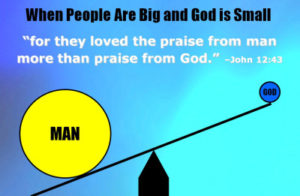
1. First, faith enlarges God and shrinks men. Charles Spurgeon said, “The fear of God is the death of every other fear; like a mighty lion, it chases all other fears before it.” The fear of God is the sense of awe before a God who is both infinitely great and infinitely good. The tension and yet harmony of His greatness and goodness, His justice and mercy, His might and His gentleness, His wrath and His love, cause a submitted, obedient, admiration in those who are His. Now the greater our sense of this God, who has made us, redeemed us, and providentially watches over us, necessarily the smaller men must seem to us.

“I, even I, am He who comforts you. Who are you that you should be afraid Of a man who will die, And of the son of a man who will be made like grass? And you forget the LORD your Maker, Who stretched out the heavens And laid the foundations of the earth” (Isa. 51:12-13). When we are deepening in our walk with God, taking in His Word, worshipping Him in private and in public, our understanding of Him should be growing. This text is saying, your god is too small, if man is your greatest concern. Jesus put it this way, when He said, “And do not fear those who kill the body but cannot kill the soul. But rather fear Him who is able to destroy both soul and body in hell” (Matt. 10:28).

Invariably, the person in the grip of the fear of man has a diminished view of God. Instead of seeing God as the Judge, they give the opinions of others more weight. Instead of seeing God as the One who atones for sins, they fret about covering their own sins from others. Instead of seeing God as the one whose approval counts, they try to gain the applause of fickle men. Instead of seeing God as the one who beautifies us with the robes of righteousness, they try to do and say the things that will make people admire.

But to the Christian growing in the knowledge of God, he can say, “So what if this person seeks to shame me. My sins are covered in Christ. His name is now mine. My reputation died with Christ. The one who will defend me is the Advocate Christ Jesus.” “So what if this person will reject me, or disapprove of me, or ridicule me. God had made a verdict on my life, being in Christ, I am accepted in the beloved. His righteousness is mine, and I long for Him to say, Well done, you good and faithful servant.” “So what if man seeks to harm me. My body is the Temple of the Holy Spirit. God will only allow that which will conform me to the image of Christ, and in the end, whatever happens to me in this body, I am eternally safe in Christ.”

There is nothing more practical than deepening your theology. Go deep in the things of God, make progress in the knowledge of God, study the person and works of God, and watch how people begin to shrink in comparison. Job was upset that he had lost his reputation, and people now scorned him, and his so-called friends accused him of evil. But once God revealed Himself to Job,all that faded away. Job said, “I have heard of You by the hearing of the ear, But now my eye sees You” (Job 42:5).

2. Second, a life of faith in God produces self-forgetfulness. When our eyes are on God, they cannot simultaneously be on man. “How can you believe, who receive honor from one another, and do not seek the honor that comes from the only God?” (Joh 5:44). Faith is antithetical to living for man’s honour. A.W. Tozer writes in The Pursuit of God: “Faith is the least self-regarding of the virtues. It is by its very nature scarcely conscious of itself. Like the eye which sees everything in front of it and never sees itself, faith is occupied with the Object upon which it rests and pays no attention to itself at all. While we are looking at God we do not see ourselves – blessed riddance!” The great joy of faith is not that it affirms self, it is that it frees us from thinking about self altogether. What a bondage, to be consumed with appearance, with reputation, with putting the right foot forward at all times. What a hard life, to always protect self against all threats, dangers, attacks. How wearisome to be ever on your guard against slights, insults, being short-changed, outdone, overlooked, ignored, misrepresented. What a freedom in being outward, in being God-focused, and a genuine servant of others. C.S. Lewis put it this way: “Christ will indeed give you a real personality: but you must not go to Him for the sake of that. As long as your own personality is what you are bothering about you are not going to Him at all. The very first step is to try to forget about the self altogether. Your real, new self (which is Christ’s and also yours, and yours just because it is His) will not come as long as you are looking for it. It will come when you are looking for Him. Does that sound strange? The same principle holds, you know, for more everyday matters. Even in social life, you will never make a good impression on other people until you stop thinking about what sort of impression you are making. Even in literature and art, no man who bothers about originality will ever be original: whereas if you simply try to tell the truth (without caring twopence how often it has been told before) you will, nine times out of ten, become original without ever having noticed it. The principle runs through all life from top to bottom. Give up yourself, and you will find your real self. Lose your life and you will save it.”

3. Third, a life of faith in God grants courage to face danger. There is no doubt that Scripture equates faith with courage. Courage is not the absense of fear. Courage is choosing to face a fear because of something more important, a greater reality. Every time God said to His people, fear not, He coupled that command with a promise. Whether it was facing enemies, or appearing before a king, or undertaking a mission, or speaking to those who would persecute them, God said, trust in Me, and obey. There is a real danger, there is a threat, but I want you to face it, with My promises. Now it is true that some fears are simply self-imposed.

We can create threats in our minds at 2am in the morning. We can brood and worry, simply because we want a level of control and certainty in our lives which is idolatrous. Pride and selfishness can demand knowledge of the future, demand control over all possible threats, and thinks that by thinking it will eliminate them. It won’t. And often, in such a mind, fears multiply But having said that, there are real threats in this world. There is a real spiritual battle going on with real and dangerous foes. The world is full of evil people. We live in tumultuous times. Uncertainty and instability abounds. Christianity is increasingly frowned upon.

And when we are surrounded with real threats, what we need is courage. We acknowledge that the danger is real, but we do not allow the danger to master us. Whether it be the danger of a child disliking you because you discipline her, or the fear of a church member taking revenge because you expose his sin – it takes courage. The fear of evangelising in a pluralistic world, the fear of travelling at night to see someone needy in the hospital, the fear of teaching others lest your weaknesses be highlighted, the fear of people’s response to you if you go into ministry or missions – these can only be countered with courage.

The life of faith is a life of courage. So much so, that the Bible says this about cowards: “He who overcomes shall inherit all things
and I will be his God and he shall be My son. But the cowardly, unbelieving, abominable, murderers, sexually immoral, sorcerers, idolaters, and all liars shall have their part in the lake which burns with fire and brimstone, which is the second death”(Rev. 21:7-8). God is compassionate on our timidity. But those who choose to reject Christ, and so do not live by faith at all, will be numbered among the cowardly. 
We are looking for safety for ourselves when we fear man. But that’s the first problem – we focus on self, and elevate our own importance above God’s glory.

The second problem is where we look for that safety – man. “Thus says the LORD: ‘Cursed is the man who trusts in man And makes flesh his strength, Whose heart departs from the LORD'” (Jer. 17:5). Once we go down that path, we find ourselves trapped in a bondage of man’s opinions and man’s actions that stifles the very joy of life. The answer is not found in self-esteem. It is not found in despising your neighbour. It is found in a life of growing faith in God – knowing and loving him. As the knowledge of Him magnifies, it puts man in perspective. As our eyes are on Him, we are relieved from forever keeping vigil over our own image. And as we live a life of faith, we can courageously face those legitimate dangers,
without being ensnared by fear of man.

  – David De Bruyn, Professor of Church History, Shepherds’ Seminary Africa

The Sinful Art of Man-Pleasing (Part 2)

“The fear of man brings a snare, But whoever trusts in the LORD shall be safe” (Prov. 29:25)

What I want us to do is to take this in two halves. First, we are going to understand the meaning of man-pleasing from God’s point of view, and second, we are going to study the cure, the obedient response that God calls for.

Let me summarise the first part of this verse:

I. Fear of Man Is a Self-Imposed Trap

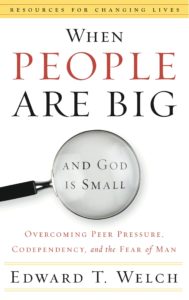
The fear of man brings a snare. A snare is a trap, a device used to catch animals. Obviously, a trap is hidden, and disguised, because it is intended to catch an animal that doesn’t want to be caught. But once caught, the animal cannot get out, and has lost  its freedom. Scripture tells us that man-pleasing is the same. Like a trap, we find ourselves in a kind of bondage. We have lost some freedom, because now what we do or don’t do is handcuffed to other people. The fear of man means your life is now constricted, you are bound, limited, perhaps even paralysed because of the fear of man. Ed Welch, in his excellent book “When People Are Big and God is Small” summarises the fear of man as being one or more of three fears: First, you can fear that people will find out what you are really like or what you have done and expose you. Second, because of something you do or are or have or say or wear, people will reject you and despise you. The third is that people will in some way or another attack us and harm us, verbally, physically. Humiliation, heckling, and harm. Shamed, shunned, and shattered.

And like every sin, there is something originally good that is twisted and perverted by pride into something evil. For example, there is a healthy sense of shame for what is wrong. The old King James talks about the virtue of shamefacedness, which meant a sense of modesty and propriety. If someone has lost the ability to blush at her own exposed nakedness, we do not admire her lack of fear of man, we say she has lost all shame. It is a good thing to not want to be exposed, to not want your sins and failing paraded. It is a good thing to want our sins covered – the question really is how and by whom.

It is also not wrong to desire the company and fellowship of people. We should want the society and friendship of godly people. There is a sense in which we should fear losing the respect and company of the right kind of people. If this weren’t true, then what good would church discipline ever do? The point of the process is that there is a sting to being excluded, there is a painful shame that is meant to goad a person to repentance. This is a good kind of fear of man. And it is definitely not wrong to want to avoid threats to life and limb. We should want to avoid the dangers of violent crime, of loss, of injury. This is an otherwise healthy love of life. The original good – desiring to have a good name and not a ruined one, the desire to have fellowship with godly people, and the desire to be free of danger to life are not evil desires. But the nature of sin is to take a lawful love and turn it into an unlawful one. It takes a good thing, and by inflating its importance, turns it into a bad thing.

And that brings us back to our summary of the first half of Proverbs 29:15: – man-pleasing is a selfimposed trap. Proverbs is not giving us this information as if we are helpless victims of the fear of man; it is meant to tell us to avoid this trap. And if we can avoid it, then we are the ones who lay it for ourselves.

It sounds contradictory – a self-imposed trap. Who tries to trap himself? Well, that’s the conflicted nature of fallen human beings. James tells us that we are capable of deceiving ourselves. That is, we tell ourselves lies until we believe them. We can suppress some truths. So in this sin, we can focus on what seems reasonable – not wanting to be humiliated not wanting to be rejected, not wanting to be harmed, but we ignore how much we want those things, we ignore what a priority we have made
those things, we fail to see how tightly we are clinging to these things. So here is the secret that Proverbs is teaching us, the fear of man is really an idolatrous love of self. I do not fear man sinfully because of my deep love for my neighbour. I fear man because of what he or she may do to me, what my neighbour may withhold from me. The sinful fear of man is not driven by a desire to love others. When trapped by the fear of man, it is because in those moments I am at the centre of my own orbit, and the gravitational pull that others have on me is because it has become so important to me that they orbit me as I want them to.

What Proverbs wants you to know is that you trap yourself when you treasure other’s opinions of you more than that of God’s, because you have placed yourself at the centre. The first issue is not how important others have become to you; it is how important you have become to you. To cave in to social pressure is not because you love yourself too little and need others to affirm you, it’s because you love yourself so much and want others to affirm you. You have to see that excessive
competitiveness is wanting to be seen as better than others, so that you would be admired. We must see our envy as a sign of desiring the praise of man for better things. We must see our excessive desire to please others by never saying no, by taking unnecessary responsibility for other’s lives, is a desire to please ourselves by using others. We want to be known as a saviour, as a wonderfully kind and merciful person. We must see our inability to say no, to withdraw for fear of hurting others is not so much a love for others as it is a love of ourselves, not wanting to appear or be known as someone who hurts others.

In other words, the fear of man is a really the love of self using man. But once we allow this selfishness to grow, soon we grant to others a place in our lives they should not have, and before long we are in fear of them. We are trapped, because now we have inflated people, and demoted God, but the root cause seems invisible to us – which is a profound selfishness. Now in a very real sense, that’s good news. Because I cannot change other people. I cannot control whether someone will humiliate me, expose me, shun me, withhold approval, slander me or harm me physically. But I can change how important that is in my own eyes. I can change whether the ultimate love in my life is self or not.

  – David De Bruyn, Professor of Church History, Shepherds’ Seminary Africa

The Sinful Art of Man-Pleasing (Part 1)

Before us today is a matter which seems to have each one of us in its cross-hairs. I doubt that anyone can consider the matter of man-pleasing, or the fear of man and feel that he or she is exempt from this sin. Indeed, the fear of man comes in so many forms, so many shapes, that it would be hard to list them all. Yes, we think immediately of the teen giving in to peer pressure, afraid of rejection, and so saying and doing things he or she wouldn’t otherwise, but for the fear of man. Or we think of the person living with a near obsession with outward appearance, continually making sure that clothing, jewelry, hair, make-up, shoes, and fashion is up-to-date, or impressive, or at least fits in with the others.

But if that manifestation of the fear of man doesn’t fit you, don’t worry, there are plenty of other kinds. There is the kind that is continually second-guessing our words and actions when we were with others, replaying them over and over, fretting over what people thought of us for saying this or that. There is the kind that lives with comparisons, comparing your parenting to another’s parenting, comparing houses, gardens, clothes, cars, holidays, children, children’s clothes, children’s schools, children’s manners, spouses. The fear of man comes in the form of being over-committed, the person who can never say no, who always picks up the slack, and takes on the tasks others dump on her. She lives in a see-saw world between guilt and resentment, feeling she must say yes, and yet angry that she does.

Facebook and social media have introduced a whole new range of fear of man flavours. Posting so as to get as many ‘likes’ and flattering comments from my friends, creating an exaggerated image of how glamorous my life is, so as to bait the veiled envy of others, or sharing with others what is either utterly ephemeral or even intensely private, encouraging others to be voyeurs, and ourselves to be exhibitionists. Checking and re-checking your posts to see who has liked it, and then fretting most over who has not, scanning through posts and despising Miss Perfect for her life, venting about some event so as to garner sympathy and pity. This is all fear of man, man-pleasing, only now it is even less human.


Some man-pleasers are social chameleons, blending their ways and manners and speech into whatever our social environment is at the time – that is the fear of man. Other man-pleasers are the class clowns, the centre of attention, the life of the party, the local comedian. Some man-pleasers are terrified of being disliked. Other man-pleasers want to be provocative and claim how little they care about what people think of them. But ironically, they do that because they want to be admired by people for being so provocative.

Some man-pleasers want peace at all costs and avoid even necessary disagreement. Other man-pleasers are competitive for everything, so long as they can keep beating other people – which is more fear of man. I have counselled man-pleasers who have made idols out of their spouses and children, and are ironically destroying the people they are supposed to love, because they are in the grip of the fear of man. I have counselled other man-pleasers who live in perpetual fear of men they have never met, timid of going out, paralysed by fear of crime.

The point is, the fear of man is in every one of us. Indeed, it is clearly a sin deeply allied with selfishness, and so wherever you find selfishness, you are going to find some manifestation of man-pleasing, the fear of man.   Now God is very aware of this tendency in our hearts, and He addresses it several times in Scripture. One of the clearest places is Proverbs 29:25: “The fear of man brings a snare, But whoever trusts in the LORD shall be safe.”

I want us to use this as our base text for understanding the fear of man. Here in Proverbs 29:25 we are going to learn of the disease and the cure, the problem, and the solution. Two phrases are laid parallel to each other – the fear of man – which brings a snare, and – trusting in the LORD, which brings safety. Hebrew wisdom literature and poetry often makes use of this parallelism – putting two thoughts side by side. Hebrew parallelism can serve many functions, but here it serves the function of contrast.

The fear of man stands antithetically to trusting in the Lord. The fear of man drives out faith in God, and vice-versa.

  – David De Bruyn, Professor of Church History, Shepherds’ Seminary Africa

The Error of Appeasement (Part 3)

“Jude, a bond-servant of Jesus Christ, and brother of James, To those who are called, sanctified by God the Father, and preserved in Jesus Christ: Mercy, peace, and love be multiplied to you. Beloved, while I was very diligent to write to you concerning our common salvation, I found it necessary to write to you exhorting you to contend earnestly for the faith which was once for all delivered to the saints. For certain men have crept in unnoticed, who long ago were marked out for this condemnation, ungodly men, who turn the grace of our God into lewdness and deny the only Lord God and our Lord Jesus Christ” (Jude 1:1-4).

III. Jude’s Explanation

“For certain men have crept in unnoticed, who long ago were marked out for this condemnation, ungodly men, who turn the grace of our God into lewdness and deny the only Lord God and our Lord Jesus Christ” (Jude 1:4)


“For”= this is the reason we must earnestly contend. Certain men have crept in unnoticed. What did they creep into? They have crept into the church, into the fellowship of the saints. The words crept in unnoticed translate one Greek word which occurs only here in the New Testament. It means to enter secretly, to slip in unnoticed, to join a group unaware. Who was unaware here? Not the false teachers! They were fully aware of what they were doing! It was the church that was unaware, that was not vigilant where it should have been, awake, thoughtful, discerning. The church was not alert enough to see who and what had already entered in. The church has a peculiar vulnerability. Christians are so conscious of the importance of brotherly love, so sensitive to not being unkind, ungodly, that they often find their love turning into sentimentality, which is where we no longer love, we start to love our love, we start to love feeling that we are nice people, we start to love feeling that we are welcoming rather than extending love and welcome thoughtfully, deliberately, intentionally. And so too many churches, for fear of being harsh, unkind, ungodly, or worse, fear of being thought unkind, unfriendly, unwelcoming, leave their front door wide open, and allow all and sundry to comfortably dwell.

Let me tell you of two ways the church leaves its front door wide open. The first is when the church does not practice any form of membership. Membership is precisely where we make sure that we are dealing with people who have been humbled at the foot of the Cross – that we are dealing with fellow-Christians. Membership is simply where we take what is mentioned in verse 3 – our common salvation, found in the doctrine once delivered to the saints, and we simply ask a person to tell us if he or she has believed that Gospel, testified of it in believers baptism, and desires to identify with this church. When a church does not practice membership, and any and every person who attends on a Sunday is as much the church as anyone else, you have just extended an invitation for a wolf to come and ravage your church. You have just said to the very kind of men Jude was warning about, “come into our church, we won’t vet you, we won’t check you, we won’t require anything. And by the time we do, you will have already had your meal, licked your lips, while we scurry around trying to figure out what just happened. Just hang around and you’re pretty much in.”

The wolf is seeking every possible avenue to draw closer, to come in, to gain a platform, to build a following, to discredit and divide. He wants to be on your prayer chain, and on the Facebook group, and the mailing list, and the ministry team. He wants to find out if membership is really just an administrative detail in your church, or if there really are shepherds guarding the flock. And the problem is this: when you don’t practise membership because you want the nice godly nonmember to feel at home, and never feel excluded, you simultaneously allow in the wolf. So when the church collapses all those distinctions between member and non-member because it has adherents it loves dearly, it has said to the wolf, come into this pasture, and eat all you wish. There is no shepherd here. Because practically speaking, a church which acts that way, doesn’t have a shepherd, or he is asleep, or he’s a coward. These men creep in unawares when the church leaves its front door wide open. It makes no distinctions, doesn’t check or vet or ask for testimonies of salvation. I’m like you. I don’t want to exclude. I don’t like good people feeling excluded. But this is not about arrogant exclusion. It is about protective exclusion. I am charged to guard the flock of God, and that means guarding the front door. You are charged to earnestly contend for the faith, and that means likewise guarding the front door, listening to the testimonies of salvation when we read them out at the Lord’s Table.

The second way these false teachers creep in unnoticed is when they are publicly recognised as Christians, particularly in a global Christianity connected by mass media and the Internet. False teachers make their home in the church
when enough Christians keep calling them “brother” or “sister”. False teachers make their home in the church when enough Christian TV or radio stations broadcast their teachings, when Christian publishing houses publish their books, when Christian conferences invite them onto their platforms to speak, when churches invite them into their pulpits to teach. Every time this happens, those who invite these false teachers say the following: even though your words, or your deeds deny the Gospel, we still affirm you as a Christian. The boundary of the faith envelops and includes you. You are one of us, and you, too, are going to Heaven.

What does this mean? It means if someone denies one of the doctrines that are crucial to the Gospel, such as the deity of Christ, the Trinity, the resurrection, the virgin birth, salvation by grace alone through faith alone, then we do not recognise that person as a Christian. Churches must not invite into their pulpit or to their conferences those who deny the Gospel. Churches must exercise caution in which authors they recommend from the pulpit. Churches should not join groups or associations that tolerate apostasy. Para-church organisations like publishing houses and media groups must not endorse or promote false teachers.

We need to name and expose those men and women who are leading people astray. You see, unless you at some point name who you are talking about when speak about false doctrine and heresy, people don’t realise you are talking about some of the people they listen to or watch or read. Membership at the local church level, naming and exposing false teachers at the universal church level is part of how we contend earnestly for the faith once delivered to the saints. Who are these men, and what do they teach? Let me give you the flyover view here:

1. First, they deny Christ in some way, and they turn grace into license to sin. who turn the grace of our God into lewdness and deny the only Lord God and our Lord Jesus Christ. (Jude 1:4) 2. Second, they live in immorality, and reject authority. 8 Likewise also these dreamers defile the flesh, reject authority, and speak evil of dignitaries. (Jude 1:8) Look out for the man who submits to no one else, who has no theological heroes he looks up to, who has no mentors he is thankful for.

3. Third, they try to turn religion into financial gain. 11 Woe to them! For they have gone in the way of Cain, have run greedily in the error of Balaam for profit, and perished in the rebellion of Korah. (Jude 1:11) False teachers are drawn to money like bees to honey. If there is profit to be made, from even the poorest of the poor, you will find them there, selling their wares. 4. Fourth, they tell people what they want to hear to gain advantage over them. 16 These are grumblers, complainers, walking according to their own lusts; and they mouth great swelling words, flattering people to gain advantage. (Jude 1:16) False teachers are marketers. They know how to tap into human need, greed, and appetite, and turn the Bible’s teachings into a formula to get those things.

5. Fifth, they are worldly, unsaved people, who live for their appetites, and divide the church through their false teachings: 19 These are sensual persons, who cause divisions, not having the Spirit. (Jude 1:19) Now some of them might get saved and leave, but the majority of them are simply unsaved. They do not have the Spirit, they are controlled by their appetites. They live only for self. These are the marks of the false teacher. But you do not have to go round hunting for them. Instead, you must busy yourself with becoming more and more familiar with the faith once for all delivered to the saints. You must know the boundaries of the Gospel. You must know Christian doctrine and practice well enough that you can sense when something is wrong. The training for those who identify counterfeit bank notes is not to expose them to all the counterfeits, because there are innumerable ways of counterfeiting. Instead, they have those people become so familiar with every details of the true bank note, so that they can instantly spot a deviation.

We must know our once-for-all-delivered-to-the-saints faith. We must know it and love it well enough to militantly oppose denials of it when we encounter them, so that those whom we disciple will receive the faith as we received it.

  – David De Bruyn, Professor of Church History, Shepherds’ Seminary Africa

The Error of Appeasement (Part 2)

“Jude, a bond-servant of Jesus Christ, and brother of James, To those who are called, sanctified by God the Father, and preserved in Jesus Christ: Mercy, peace, and love be multiplied to you. Beloved, while I was very diligent to write to you concerning our common salvation, I found it necessary to write to you exhorting you to contend earnestly for the faith which was once for all delivered to the saints. For certain men have crept in unnoticed, who long ago were marked out for this condemnation, ungodly men, who turn the grace of our God into lewdness and deny the only Lord God and our Lord Jesus Christ” (Jude 1:1-4).

Jude will often refer his readers back to their position in Christ as their best defence against false teaching. In fact, Jude was so excited about salvation, so enthused about the Gospel, that it was his original intention to write a letter about the Gospel.

II. Jude’s Exhortation

“Beloved, while I was very diligent to write to you concerning our common salvation, I was very eager, giving all my energy to the project of writing to you about the salvation we share” (Jude 1:3a).

Jude wanted to bless his readers with something like Paul’s letter to the Ephesians – a rejoicing in the unsearchable riches of Christ. And who wouldn’t want to do that? As a pastor, I identify with Jude. I would much prefer to encourage the saints with their position in Christ than talk about almost anything else. But sometimes the urgent has to intrude. Something interrupted Jude’s plans, and caused him to change topic.

“I found it necessary to write to you exhorting you to contend earnestly for the faith which was once for all delivered to the saints” (Jude 1:3b)

That’s our main verb of this section: it was necessary. “Needful it was for me”, instead of doing what I’d have preferred to so, I chose to write what was urgent. I chose to write to encourage and strongly urge you to do something. I would have enjoyed reviewing our treasured salvation, but there is an action needed from you, and I had to exhort you to do it.

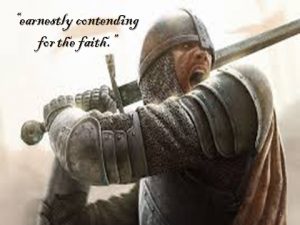
What was this urgent exhortation? Jude wanted to exhort his readers to contend earnestly for the once-for-all-delivered-to-the-saints faith. Contend earnestly translates a word found only here in the Greek New Testament. It has athletic imagery in it, picturing an athlete straining. It has military imagery in it, picturing going to do battle. The idea is Christians must militantly defend and struggle on behalf of the faith. Christians can find themselves swept up in the spirit of the age, which is pluralism, inclusivism, relativism. The world is happy for us to believe what we want, as long as we are not dogmatic, as long as we do not call other beliefs errors, call other religions false. But if Christians do that, they are hiding their lamp under a bushel, they are refusing to be salt.


Christianity is always just one generation away from extinction. All it takes is for one generation of Christians to not earnestly content for the faith, not defend sound doctrine, not preach a true Gospel, and then Christianity will die with that generation. Christianity must be passed on. That’s why Jude uses a very interesting set of words here to describe the faith. He calls it the faith which was once for all delivered to the saints. That’s really one phrase. It’s a body of orthodoxy, orthopraxy, orthopathy, that was delivered by Christ and His apostles to the church, and has now been handed down. Once God had spoken through the apostles and prophets, and inspired all 66 books of the Bible, the once-for-all-delivered-to- the-saints- faith. Paul often enough speaks to Timothy and Titus about what he had entrusted to them, which they must now entrust to others. One of the marks of false teachers is that they claim to have special revelation, a special direct message from God, a prophecy not yet recorded in God’s Word.

But the old saying is, “if it’s new, it’s not true, and if its true it’s not new.” Jude wants us to take the whole counsel of God represented by the 66 books of the Bible, and defend that, and teach that to others, who will teach others also. This is the right sense in which to speak about tradition. When biblical teaching is handed down from one generation to another, it is a biblical tradition. This is the sense in which we the word conservative. When we say we are conservative Christians, it means we believe we are commanded to conserve the whole faith that was once delivered to the saints, and hand it down unedited, not adding or subtracting from it. Once Christians begin innovating, adding unbiblical practices, or claiming that God’s once-for-all-delivered-to-the-saints message is not complete because they have a new prophecy, and message from God, those Christians are not conserving the faith, not contending for the faith. They become part of the problem.

That leads us to Jude’s explanation for his exhortation…

  – David De Bruyn, Professor of Church History, Shepherds’ Seminary Africa

The Error of Appeasement (Part 1)


“Jude, a bond-servant of Jesus Christ, and brother of James, To those who are called, sanctified by God the Father, and preserved in Jesus Christ: Mercy, peace, and love be multiplied to you. Beloved, while I was very diligent to write to you concerning our common salvation, I found it necessary to write to you exhorting you to contend earnestly for the faith which was once for all delivered to the saints. For certain men have crept in unnoticed, who long ago were marked out for this condemnation, ungodly men, who turn the grace of our God into lewdness and deny the only Lord God and our Lord Jesus Christ” (Jude 1:1-4).

In the years leading up to World War 2, the British Prime Minister Neville Chamberlain tried to avoid war by continually giving in to the demands of Adolph Hitler. He was famous for saying he believed it would be ‘peace’ in our time. But the more Germany was appeased, the more it wanted to take. It became clearer that the only appeasement Hitler would accept would be a total surrender. His opponent, Winston Churchill, bitterly opposed appeasement, and said about Chamberlain, “He was given a choice between war and dishonor. He chose dishonor and he will have war anyway.” Churchill said this about appeasement: An appeaser is one who feeds the crocodile hoping it will eat him last.

In the church, we sometimes find a similar situation. We find threats to Christianity in the form of false teaching, false worship, false practices. As these threats grow, Christians can just hope these threats will go away, but that is the theory of the turtle.  Like Hitler, false teachings and teachers do not go away by themselves. At some point, Christians have to be willing to fight, to defend, to contend for the faith. That’s what the small book of Jude is about. The book of Jude is the fourth shortest epistle in the New Testament, behind Philemon, and 2nd and 3rd John. It’s a letter that came out of an urgency in the writer’s heart. He wanted to write to help his readers to stop appeasing false teachers, and to begin manning the defences, and launching some counter-attacks.

Though there were particular threats in Jude’s time which are different to ours, the dangers have not grown less since his time. With the Internet, false teaching and false teachers no longer have to show up in our churches. They can do their work during the week on screens, through earphones, in books. Like never before, we need the Spirit-inspired truths of the book of Jude.


I. Jude’s Exordium

“Jude, a bondservant of Jesus Christ, and brother of James, To those who are called, sanctified by God the Father, and preserved in Jesus Christ: 2 Mercy, peace, and love be multiplied to you” (Jude 1:1-2).

In the first century, you began a letter with the author’s name, and then wrote who you were writing to, and you typically added a short, polite greeting, like the Greek word charein. The author identifies himself as Jude, which is the same name as Judas. Judas is the Greek form of the Hebrew name Judah. There are really only two contenders for who this author was. The first is the apostle Jude, or Judas, who is mentioned in Luke 6:16. Remember, of the twelve Jesus had two disciples named Judas: one was Judas Iscariot, and one was Judas the son of James. This obviously was not written by Judas Iscariot. The other Judas cannot be the author because here this Judas is said to be the brother of James, not the son of James. That only leaves one other Judas, related to James. We read in Matthew 13:55 “Is this not the carpenter’s son? Is not His mother called Mary? And His brothers James, Joses, Simon, and Judas? Jesus had several half-brothers and half-sisters through Mary. One of them was James, who became the pastor of the church at Jerusalem. Another was named Judas. It’s he that is writing here, and identifies himself as the brother of James.

Why didn’t he identify himself as ‘the brother of our Lord’? The answer has to be: humility. Neither James, nor Jude, presume to use their physical relation to Christ as a boasting point. Since God can raise up sons of Abraham from stones, and since Jesus told a crowd that his true mother, brothers, and sisters are those who do the will of the Father, neither of these men use the fact that Jesus was their half-brother as some kind of qualification. Indeed, as Gentiles were now coming into the faith, they wanted to get away from the idea that ethnicity gave you spiritual standing with God. So Judah identifies himself as the brother of James, but as a bondservant, a doulos, of Jesus Christ. Far from claiming some sort of special relationship to Christ, he describes himself in the lowest possible relationship to Christ – a slave, a purchased possession. There was a time in Jude’s life when he

rejected his half-brother, but at some point, probably shortly after the Resurrection, Jude came to faith. He turned from trusting in his own righteousness, leaning on tradition, and turned to the one, who according to his human nature, was his half-brother, but according to His divine nature, was His Creator, Lord, and Saviour.

He then names whom he is writing to. He is writing to those who are called, sanctified by God the Father, and preserved in Jesus Christ. All those who are called, set apart by God the Father, and preserved in Jesus Christ are the recipients of this letter. Those are three ways of referring to a true, born again believer. If you are a true Christian, then at some point, God called you to salvation. You heard the Gospel, and it felt like this message had your name on it. The Spirit was drawing you in. Once you believed on the Lord Jesus Christ, you were set apart, which is the meaning of sanctified. God took you out of the Devil’s family, out of being used as a vessel for unrighteousness, and put you in His family, and reserved you for His use.

And not only did God call you and set you apart, He preserves you as well. The word here means to guard, to keep, to protect. If God is going to pay such a high price to redeem you, He is not going to lose you, so in Jesus Christ, you are preserved. Both of those words sanctified, and preserved are in the passive perfect, which means this is something God has completed in the past, which has continuing effects into the present. Jude lovingly wishes his readers a multiplying of mercy, peace, and love.

Now why do you think Jude has taken all this time to describe himself, and to describe his readers? Why didn’t he just say, “Jude, to all Christians, greetings”? The answer is that Jude is setting up the content of his letter. He has to say some hard things, and he wants them to know he is not lording it over them, but is serving them. But he wants his readers to know that there is a real difference between the people he is writing to, and the people he will be writing about. He is not writing to false teachers, to apostates. He is writing to true believers about false teachers. And in these first lines, he encourages them with the truth that if they are in Christ, they are kept in Jesus Christ, they are set apart, called. This is a theme which will come up again in this book: But you, beloved, building yourselves up on your most holy faith, praying in the Holy Spirit, keep yourselves in the love of God, looking for the mercy of our Lord Jesus Christ unto eternal life… Now to Him who is able to keep you from stumbling, And to present you faultless Before the presence of His glory with exceeding joy” (Jude 1:20-21, 24).

  – David De Bruyn, Professor of Church History, Shepherds’ Seminary Africa